Our answer, up front
The best-supported statement today: in genetically diverse mice, caloric restriction (CR) extends lifespan proportionally to dose — the 40% CR group lived a median ~9 months longer than ad libitum (+36%), a conclusion we reproduced from the raw data. Yet in the same study, genetic background explained three times more lifespan variance (23.6%) than diet (7.4%). Intermittent fasting (1–2 fasting days per week, with little reduction in total calories) also extended mouse lifespan, but only in animals that were not heavy before the intervention. In humans, two years of moderate restriction (~12% achieved) genuinely improved metabolic markers and slowed one "pace of aging" biomarker by 2–3%, at the cost of bone density and lean mass. For human lifespan itself there is no direct evidence, and there will not be for a long time.
What each layer of evidence answers:
| Layer | What we did | What we found | What it does not answer |
|---|---|---|---|
| Mouse lifespan (reanalysis) | Recomputed KM/RMST/Cox/Gompertz from 937 individual records | 40% CR vs ad libitum median +278 days (+9.1 months, +36.3%), matching the paper; dose gradient holds | Males were not studied; lab-to-human extrapolation |
| Mouse genetics vs diet | Variance decomposition | Diet explains 7.0% of lifespan variance, rising to 11.1% in older survivors — matching the paper's 7.4%→11.4%; genetics (paper's kinship estimate) 23.6% | Without per-mouse genotypes we can cite but not recompute h² |
| Mouse weight strata | Recomputed median-split analyses | CR extends lifespan in both lighter and heavier halves; fasting shows no statistical evidence in the heavier half (1D p=0.21, 2D p=0.065) | Strata use weight z-scores, not clinical obesity |
| Primates | Primary-source check of both 20+ year trials | Wisconsin: age-related mortality HR 3.0 (p=0.03); NIA: no survival benefit (same-measure p=0.975) | After design differences are accounted for: direction leans positive, magnitude unsettled |
| Humans (CALERIE et al.) | Layered extraction from primary papers | 25% prescribed, 11.9% achieved; metabolic markers improved; DunedinPACE slowed 2–3%; spine/hip BMD and lean mass declined | No direct data on human lifespan or healthspan endpoints |
Scope: the state of evidence on "eating less (caloric restriction and intermittent fasting) and lifespan/aging." This is not dietary advice, does not address weight-loss therapy in people with obesity, and does not cover the separate evidence on time-restricted eating.
Why this mouse study deserved a reanalysis
In October 2024, Di Francesco et al. published the DRiDO study in Nature: 960 Diversity Outbred (genetically heterogeneous) mice randomized to five arms — ad libitum (AL), fasting one day per week (1D), two consecutive days per week (2D), 20% CR, or 40% CR — starting at 6 months of age, with the 937 animals alive at intervention start followed until natural death. Original paper
It differs from textbook CR experiments in three ways: genetically diverse mice rather than inbred strains (closer to human population variation); intervention begun in midlife rather than at weaning; and over 200 health traits measured alongside lifespan. Its headline — genes matter more than diet — was widely covered.
The authors released individual-level data on GitHub (MIT license). We re-ran the analysis independently in R: first 17 consistency checks of the released data against the paper (sample sizes, group counts, censoring, the authors' saved trait–lifespan coefficients), all passing; then an independent survival reanalysis. Reproduction package
Reanalysis 1: the dose gradient holds, matching the paper
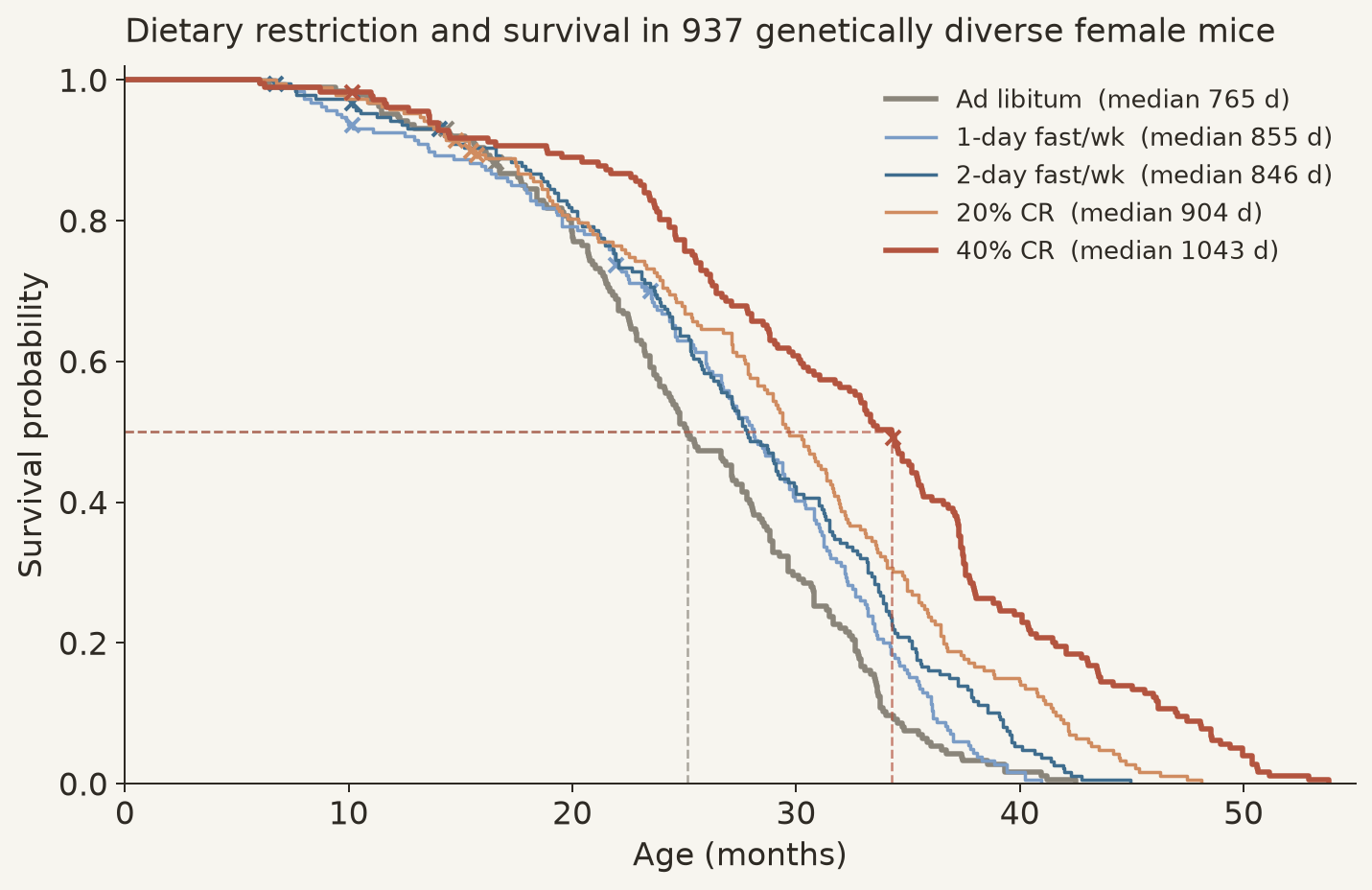
Our recomputed median lifespans (Kaplan–Meier): ad libitum 765 days, 1-day fast 855, 2-day fast 846, 20% CR 904, 40% CR 1043 days. The 40% CR group lived 278 days longer than ad libitum — 9.1 months, +36.3%, exactly the paper's "about 9 months (36.3%)." Overall log-rank P=1.3×10⁻²³ (test statistic). Group estimates with CIs
Three statistical lenses agree. Restricted mean survival time (common horizon τ=41 months): +182 days for 40% CR (95%CI 131–234), +100 for 20% CR (51–148), +64 for 2-day fasting (14–112), +37 for 1-day fasting (−10–85, crossing zero). A Cox model stratified by birth generation gives hazard ratios vs AL: 0.33 (0.26–0.41) for 40% CR, 0.55 for 20% CR, 0.70 for 2D, 0.82 for 1D (0.67–1.00, marginal). RMST with bootstrap Cox results
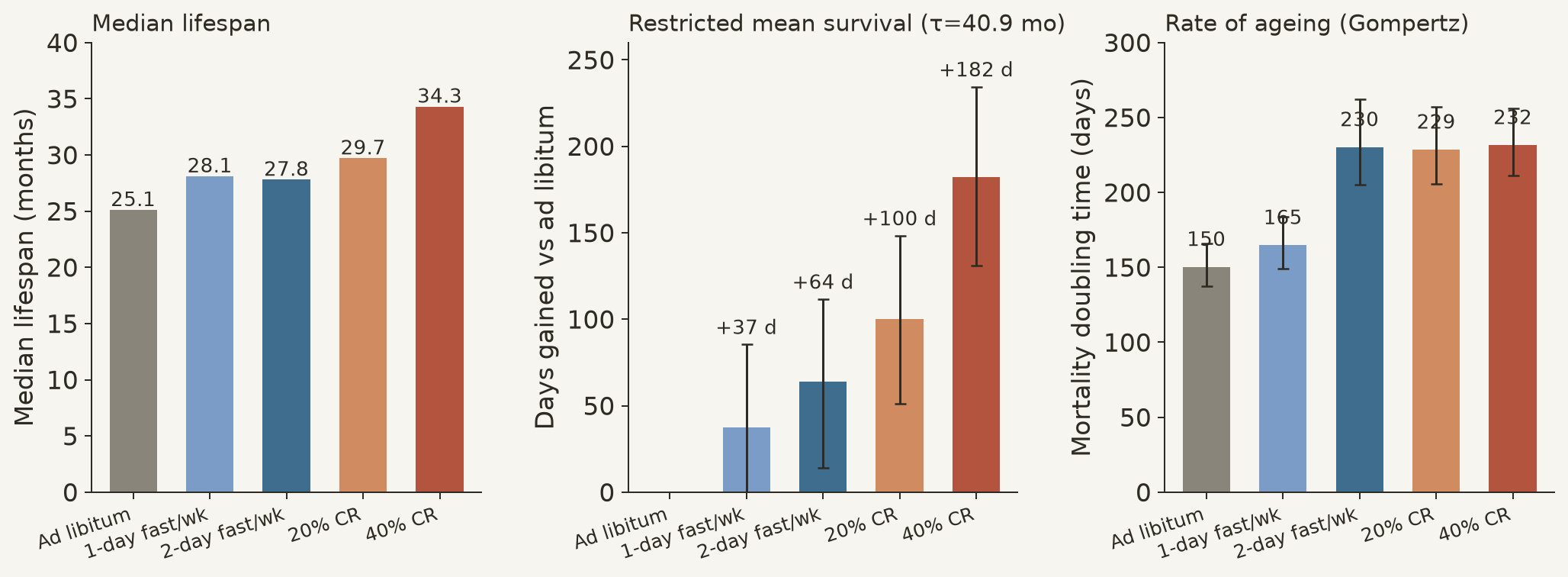
One more layer is the rate of ageing itself: fitting Gompertz mortality models, the mortality doubling time is 150 days on ad libitum but ~230 days on 40% CR, 20% CR and 2-day fasting — the rate at which mortality accelerates was more than halved; the 1-day fast group (165 days) was not distinguishable from control. Gompertz fits
Two honest footnotes. First, the paper's ordering "40 > 20 > 2D > 1D > AL" comes out slightly differently in our medians — 1D (855 d) edges 2D (846 d), with heavily overlapping CIs; on the whole-curve RMST measure the paper's ordering is restored (2D 840 > 1D 813). The data cannot rank the two fasting arms. Second, the proportional-hazards test is significant (p=0.009): hazard ratios vary over time, so each Cox HR should be read as an average effect.
Reanalysis 2: genes explain three times more than diet
The paper's most-quoted number: among mice alive at 6 months, genetic background explained 23.6% of lifespan variance (h²=0.236, 95%CI 0.106–0.360, kinship-matrix model), versus 7.4% for diet. Original paper
We could independently verify half of that. Our variance decomposition on the same data: diet explains 7.0% of lifespan variance, rising to 8.8% and 11.1% in mice surviving past 12 and 18 months — point-for-point agreement with the paper's 7.4%→8.4%→11.4%, including the direction "diet's share grows with age." Variance decomposition
The genetics half cannot be recomputed: the released data contain no per-mouse genotypes. Using birth generation as a crude proxy explains 0.4% — unsurprising, since DO genetic diversity sits at the individual level. So we flag "genes three-to-one over diet" as cited from the paper, not independently verified; its confidence interval is wide (11–36%), and the exact ratio should not be taken literally, though the direction (genetics larger than diet) is supported by the paper's model.
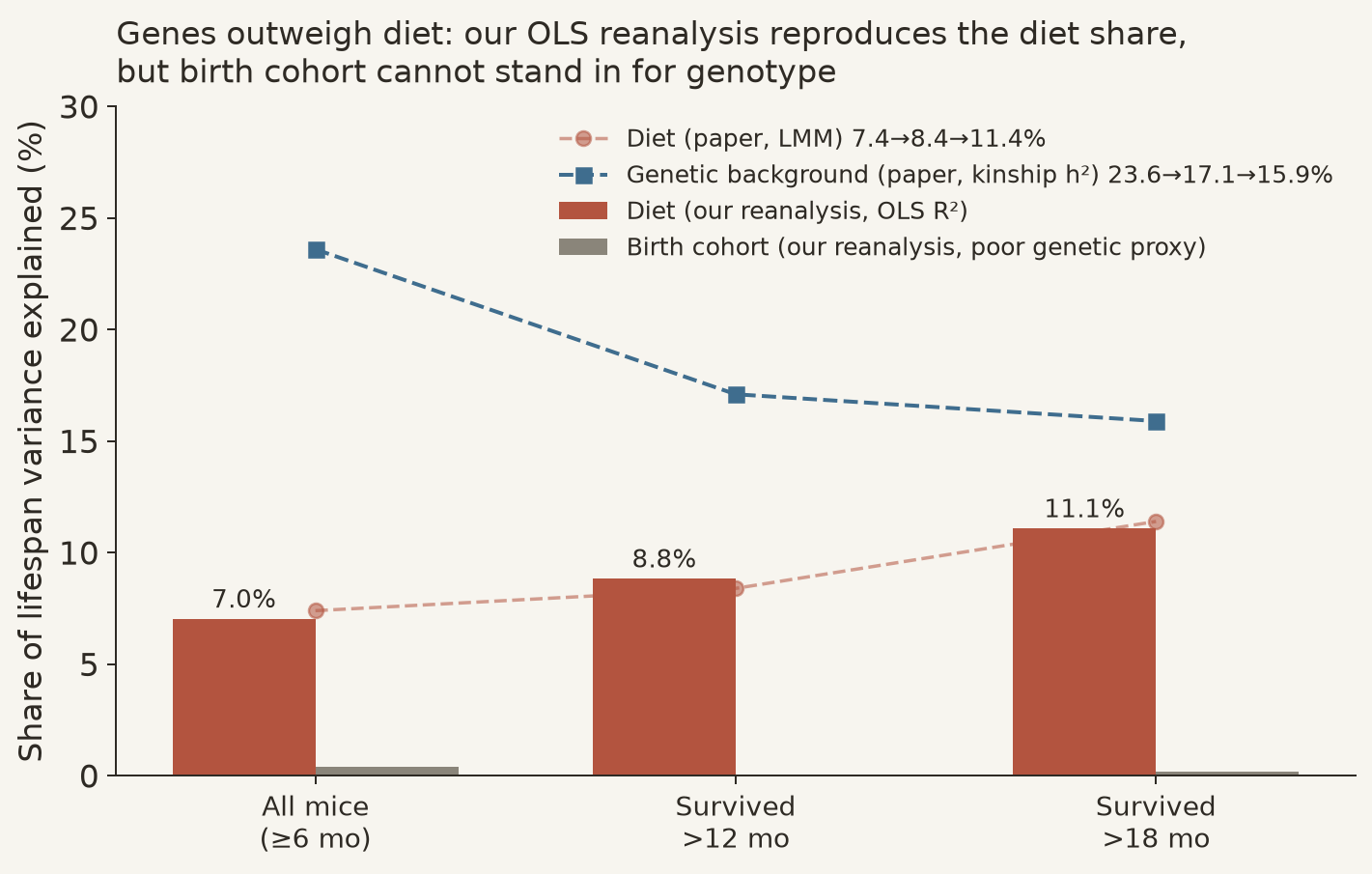
The practical reading: under identical housing, two mice differ in lifespan more because of their genomes than their bowls. That does not weaken the diet effect — it bounds its size.
Reanalysis 3: body weight, dose, and why "it's just weight loss" fails
Splitting at median 6-month body weight (469 light, 468 heavy) and recomputing: CR extends lifespan significantly in both halves (20% and 40% CR vs ad libitum: light half p=1.8×10⁻⁴ and 3.2×10⁻⁷, heavy half p=3.9×10⁻⁵ and 7.4×10⁻¹⁵; median gains 115–292 days). Fasting's effect concentrates in the lighter half — light-half 2-day fasting p=0.006, while in heavier mice 1-day fasting p=0.21 and 2-day fasting p=0.065, both without statistical support. This matches the paper: fasting did not extend life in mice with high pre-intervention weight. Stratified reanalysis
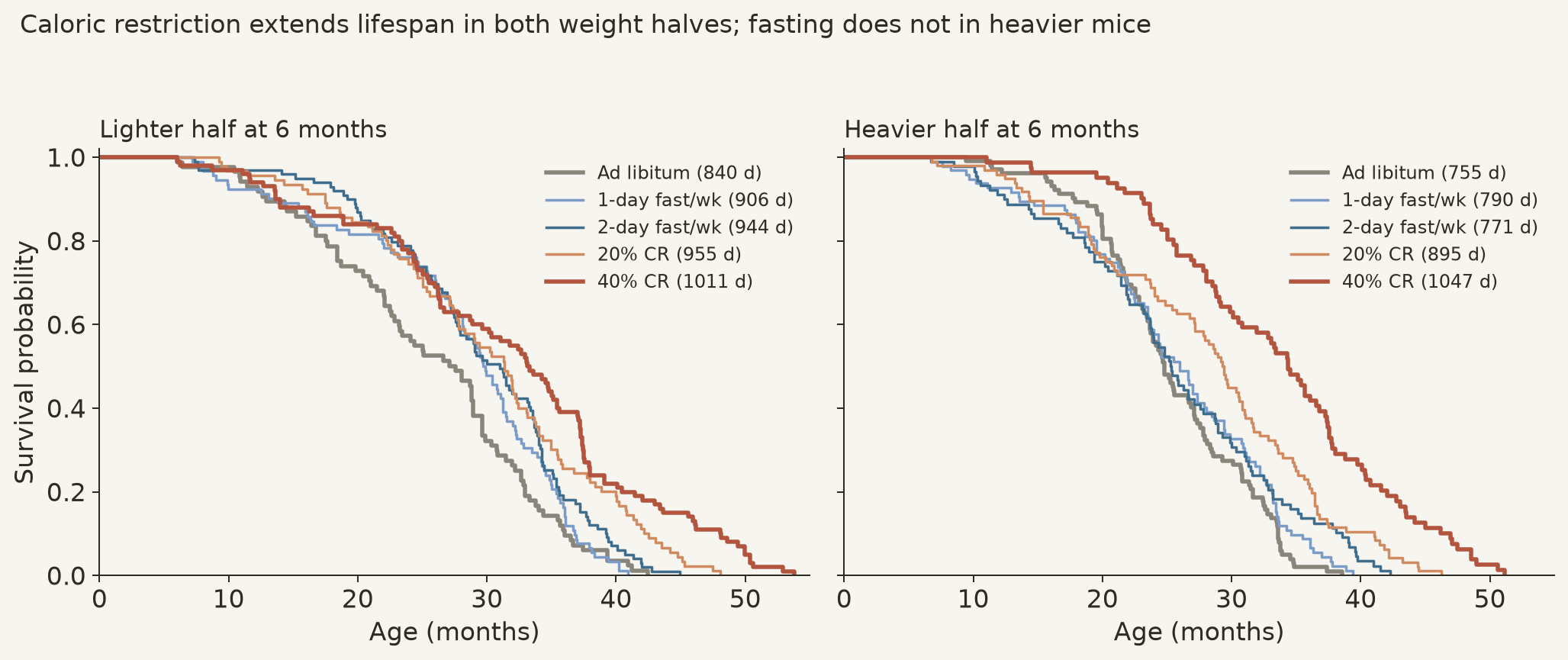
A counterintuitive detail: among ad libitum mice, lighter animals at 6 months lived longer (840 vs 755 days, p=0.059); inside the 40% CR group, baseline weight no longer predicted lifespan at all (p=0.90) — severe restriction erased the head start of being naturally lean. Within-group contrasts
Most worth remembering is the paradox the paper itself stresses, which our reanalysis supports: CR groups lost weight and lived longer, yet within each group, the individuals that retained more weight lived longest. Weight retention across the 10–11-month phenotyping period ("PhenoDelta") was the strongest lifespan correlate among all 200+ traits — our Spearman ρ=0.256 (p=7×10⁻¹⁵) against the paper's adjusted r=0.287 — and weight loss at any age tracked shorter lifespan. The paper explicitly rejects "CR merely counteracts obesity": the benefit of eating less does not fit inside the word "slimming." Trait–lifespan associations
The monkey fight: two 20-year trials, two answers
Only two long-term primate CR trials exist, superficially contradictory; both checked at primary source.
Wisconsin (WNPRC), reported 2009: adult-onset (7–14 y) 30% CR cut age-related mortality roughly threefold (HR=3.0, p=0.03; age-related deaths 37% vs 13%) and halved diabetes, cancer and cardiovascular disease — but all-cause mortality was not significantly different (p=0.16). Colman 2009 A 2014 update reported all-cause mortality reaching significance. Colman 2014
National Institute on Aging, reported 2012: the same 30% CR produced no survival benefit — age-related deaths 24% vs 20% (control vs CR) in young-onset animals, Cox p=0.975 on that measure (all-cause p=0.255); old-onset all-cause p=0.934. Metabolic measures improved; lifespan did not move. Mattison 2012
A 2017 joint analysis attributed the divergence to enumerable design differences: NIA's control diet was 3.9% sucrose versus 28.5% in Wisconsin's (Wisconsin controls were effectively junk-food-fed, with high baseline mortality); NIA controls were portion-fed rather than truly ad libitum (themselves mildly restricted); and ages of onset differed. Joint analysis Pooled, the primate direction still leans positive, but the magnitude is far less stable than in mice. One more within-species warning: back in 2010, about a third of 41 recombinant inbred mouse strains lived shorter lives under CR, and wild-caught mice showed no overall benefit. Liao 2010
Humans: CALERIE's three-layer answer
Nearly all direct human evidence comes from CALERIE phase 2: of 238 eligible volunteers, 220 were randomized (145 CR, 75 control), prescribed 25% restriction for 2 years; 11.9% was actually achieved (19.5% in the first 6 months, ~9% thereafter), with 218 in the intention-to-treat analysis. Ravussin 2015 Three layers, stated separately.
Metabolism and weight — genuine improvement. CR lost 7.5 kg (maintaining −10.4%), including −2.2 kg of lean mass; LDL, total-cholesterol:HDL ratio, blood pressure, C-reactive protein and insulin sensitivity all improved, by more than weight loss alone would predict. Kraus 2019 Resting metabolic rate adjusted for body composition fell significantly at 12 months (p=0.04, suggesting "metabolic adaptation") but not at 24; core temperature did not differ; thyroid hormone T3 stayed lower. Ravussin 2015
Pace of aging — one small signal. Two years of CR slowed the DNA-methylation pace-of-aging measure DunedinPACE by 2–3% (the control group's pace was unchanged); the PhenoAge and GrimAge clocks showed no between-group difference over the same period. This is the only "slower pace of aging" signal ever seen in a human RCT, but it is ~2% per year on a surrogate marker — not lifespan evidence. Waziry 2023 Immunologically, CR preserved thymic function and pointed to a druggable inflammatory gene, PLA2G7, whose suppression reproduced part of the benefit in mice. Spadaro 2022
Safety — real costs. Bone mineral density fell significantly at lumbar spine, total hip and femoral neck (about −0.013 to −0.017 g/cm², between-group p≤0.03) — in young, non-obese adults; lean mass fell 2.2 kg while strength was preserved; overall adverse-event rates did not differ significantly (serious events 1 CR vs 7 control); dropout was higher on CR (18.2% vs 5.3%). Villareal 2016 Safety analysis
Lifespan — no direct evidence. No trial has randomized people to eat less and counted the years; none can, practically. Observational data offer an intriguing hint: in the WHI cohort, biomarker-calibrated lower energy intake was associated with lower all-cause mortality in younger postmenopausal women, with the direction reversed in the oldest group. Prentice 2024 Observational association is not causation, but it points the same cautious direction as the lean-mass and immune trade-offs seen in 40% CR mice.
The four competing explanations, judged
| Competing explanation | Current evidence | Verdict |
|---|---|---|
| Genuine nutrient-sensing extension: CR slows the rate of ageing via mTOR/IGF-1/energy-sensing pathways | Dose gradient, halved Gompertz slope, multi-species replication; coherent mechanism | Holds in animals; only a small surrogate-marker signal in humans |
| "Just fixing overfeeding": controls eat too much; CR merely restores normality | Within 40% CR, baseline weight stops predicting lifespan; weight retainers live longest; benefits exceed what weight loss explains | Cannot explain everything, but a partial contribution cannot be excluded (NIA's portion-fed controls lived fine) |
| Individual differences / reverse causation: naturally healthy animals are both leaner and longer-lived | Randomized assignment; CR effect persists within weight strata; the fasting-in-heavy-mice null is itself direct evidence of effect modification | Randomization removes the main confounding; genuine effect modification exists |
| Measurement and publication selection: positive results amplified | Our independent reanalysis matches the paper; but the negative side is equally documented (NIA primates, ~1/3 of mouse strains shortened, null PhenoAge/GrimAge) | Excluded at the computation level; at the communication level, a flat "strong evidence" label did over-compress the disagreement |
What we know, and what we don't
Known: in genetically diverse mice CR extends lifespan proportionally to dose (independently reproduced; +36% median at the highest dose); genetics outweighs diet; CR's benefit does not depend on baseline leanness while fasting's does; CR is not a synonym for weight loss; moderate restriction in humans improves metabolism, slightly slows a pace-of-aging marker, and costs bone; primate results lean positive but unstable.
Unknown: any human lifespan effect at any dose (no direct evidence); male mice (this study was all-female); the long-term human safety window of CR (the bone findings' downstream meaning is unsettled); any lifespan effect of fasting in humans (even the animal evidence is conditional); whether the "better metabolism → more years" bridge can be built in humans.
Methods, reproduction and updates
This is an evidence audit of one primary question, combining an independent survival reanalysis of a public animal dataset with layered extraction of primary human and primate literature; it is not a systematic review and includes no new wet-lab work. Search cutoff 2026-09-18, covering the original paper and its public data, the CALERIE primary literature, both primate trials and their joint analysis; search strings and coverage gaps are in the research record.
Download the reproduction package: the pre-registered analysis plan (with decision rules), all R/Python code, input manifest with SHA256 hashes, and all output tables. Individual mouse data come from the authors' GitHub repository (MIT license) and are not redistributed per repository policy; the paper text is not redistributed. Known gaps: the authors' full Figshare archive was unreachable from our network on the search date (HTTP 403), so we anchored on the GitHub release cross-checked against paper-reported numbers; the release contains no sex field (the study was all-female by design) and no genotypes, so sex stratification and heritability cannot be independently recomputed — both flagged accordingly.
First published: 2026-09-18; next scheduled evidence review: 2027-03-18; earlier if CALERIE long-term follow-up, male DRiDO data, or a new large animal trial appears.
Authorship, computation, translation checking and editing were all performed by the same Kimi AI agent, with no independent agent, human, or clinical review. Per-source reading depth, conflicts and remaining limitations are in the record below.
Scope & limitations
- The mouse study is all-female, with no data of any kind for male extrapolation; the laboratory environment differs enormously from free-living human conditions.
- The full Figshare archive (Supplementary Tables 1-11 and more) returned HTTP 403 from our network; we anchored on the GitHub release cross-checked against paper-reported numbers, and values inside the supplementary tables were not independently checked.
- Per-mouse genotypes are not in the released data, so h²=23.6% can only be cited, not recomputed; the birth-generation proxy (0.4%) cannot disprove the genetics side.
- Released body weights are within-generation rank-normal z-scores, not raw grams; the weight stratification and association analyses rest on z-scores.
- Our Gompertz and Cox conventions are not identical to the paper's flexsurv settings; for 2-day fasting our doubling-time estimate leans significant while the paper's text calls IF non-significant — the difference is recorded as-is.
- The human layer is a single 2-year RCT system (CALERIE) at ~12% dose, far below the 30-40% animal doses; no data on lifespan or healthspan hard endpoints.
- The 1D and 2D fasting arms cannot be ranked on median lifespan (confidence intervals overlap).
- The same AI agent performed authorship, computation, self-review, translation checking and editing; there is no independent or clinical professional review.
Sources
- Di Francesco A et al. Dietary restriction impacts health and lifespan of genetically diverse mice (Nature 2024;634:600-609)
Primary research · Source version: 2024; PMC11485257; retrieved 2026-09-18
Reading scope
Full text
Read word by word: design, survival, weight strata, variance decomposition and methods; supplementary tables unobtained (Figshare 403), so paper-reported numbers serve as the reanalysis anchors
- Abstract; Results (lifespan/body weight/genetics sections); Fig. 1-2, 5 legends; Methods (Survival analysis/Trait associations/QTL mapping); Data availability
- calico/DRiDO_Paper_Release: the paper's per-animal data and code (GitHub, MIT)
Dataset and code · Source version: commit 28f84d361bb87843bcec1a0d7a3d38dcda70325b (2024-08-19); retrieved 2026-09-18
Reading scope
Full text
The 937-row per-animal data passed all 17 consistency checks against the paper; SurvTest anchors (r=-0.134/0.287 etc.) match the figure legends; our B-series recomputation uses this CSV as its only input. Integrator re-check 2026-09-18: the SHA256 prefixes of phenotyping_data.csv and SurvTest.csv and commit 28f84d36 all match the record; local_path was changed from the directory to this CSV (the schema requires a single file), with the repository's other files still listed under locations.
- data/phenotyping_data.csv (SHA256 23c20891...); data/SurvTest.csv (SHA256 bc4aab6a...); plots.ipynb; DRiDO/study_utils.py
- Waziry R et al. Effect of long-term caloric restriction on DNA methylation measures of biological aging in healthy adults from the CALERIE trial (Nat Aging 2023;3:248-257)
Primary research (RCT secondary analysis) · Source version: 2023; retrieved 2026-09-18
Reading scope
Full text
Full text archived in the RESEARCH-001 evidence store and checked section by section
- Main results (DunedinPACE 2-3%; no between-group difference in PhenoAge/GrimAge); Methods (220 randomized / 218 ITT / DNAm n=197)
- Colman RJ et al. Caloric restriction delays disease onset and mortality in rhesus monkeys (Science 2009;325:201-204)
Primary research · Source version: 2009; retrieved 2026-09-18
Reading scope
Full text
PMC full text checked section by section; note all-cause mortality was not significant at that time point. Integrator 2026-09-18 archived the original and re-verified: 37% (14/38) vs 13% (5/38), age-related mortality Cox p=0.03, HR 3.0 and all-cause p=0.16 match the text verbatim.
- Abstract; mortality analysis (age-related 37% vs 13%, HR 3.0, p=0.03; all-cause p=0.16); Fig. 2-3
- Colman RJ et al. Caloric restriction reduces age-related and all-cause mortality in rhesus monkeys (Nat Commun 2014;5:3557)
Primary research · Source version: 2014; retrieved 2026-09-18
Reading scope
Abstract
Checked at abstract and figure-legend level
- Abstract; Fig. 1 (age-related HR 2.89, p=0.007; all-cause HR 1.78, p=0.037)
- Mattison JA et al. Impact of caloric restriction on health and survival in rhesus monkeys from the NIA study (Nature 2012;489:318-321)
Primary research · Source version: 2012; retrieved 2026-09-18
Reading scope
Full text
PMC full text checked section by section. Integrator 2026-09-18 archived the original and, after re-checking, corrected the p-value framing: young-onset age-related deaths 24% (11/46) vs 20% (8/40), Cox diet term on that measure p=0.975 (Fig. 3b legend); p=0.255 is the same group's all-cause measure (Fig. 3a legend), which the record had previously attached to age-related mortality. Old-onset all-cause p=0.934, sex p=0.003. The value comparable to Wisconsin's p=0.03 on the same measure is 0.975.
- Abstract; Old-onset/Young-onset survival analyses; Table 1 (food intake); Discussion (diet sucrose 3.9% vs 28.5%, portion-fed controls, genetic diversity)
- Fig. 3a legend (all-cause Cox diet p=0.255); Fig. 3b legend (age-related Cox diet p=0.975); Fig. 2 legend (old-onset p=0.934)
- Mattison JA, Colman RJ et al. Caloric restriction improves health and survival of rhesus monkeys (Nat Commun 2017;8:14063)
Primary research (joint comparison of the two trials) · Source version: 2017; retrieved 2026-09-18
Reading scope
Abstract
Checked at abstract level; the joint conclusion is that health benefits are conservative across monkeys, with survival benefit stratified by design and age of onset
- Abstract (design-difference attribution, conservative health benefit, species-specificity of age of onset and diet)
- Ravussin E et al. A 2-Year Randomized Controlled Trial of Human Caloric Restriction (J Gerontol A 2015;70:1097-1104)
Primary research (RCT) · Source version: 2015 (with 2016 erratum); retrieved 2026-09-18
Reading scope
Abstract
Checked at abstract and figure-legend level (PMC4841173 record confirmed)
- Abstract (238 eligible / 220 randomized / 218 ITT; achieved 11.7±0.7% CR; maintained weight -10.4%; RMR residual p=.04 at 12 months, not significant at 24; no core-temperature difference; T3 p<.001); CONSORT legend
- Kraus WE et al. 2 years of calorie restriction and cardiometabolic risk (CALERIE) (Lancet Diabetes Endocrinol 2019;7:673-683)
Primary research (RCT exploratory outcomes) · Source version: 2019; retrieved 2026-09-18
Reading scope
Abstract
Checked at abstract level; the claim that effect sizes exceed what weight loss explains matches the abstract
- Abstract (~12% achieved restriction; ~-7.5 kg body weight; LDL/TC:HDL/blood pressure/CRP/insulin sensitivity improved)
- Liao CY et al. Genetic variation in the murine lifespan response to dietary restriction: from life extension to life shortening (Aging Cell 2010;9:92-95)
Primary research · Source version: 2010; retrieved 2026-09-18
Reading scope
Not obtained
Original not obtained; checked as cited in the Mattison 2012 full text; Harper 2006's null overall effect in wild-caught mice comes from the same passage (reading level set to unobtained by the integrator per this library's scale; previously recorded as cited_passage, which is not a valid level here.)
- Checked via citation in the s5 full text: about a third of 41 recombinant inbred strains had shortened lifespan under CR
- Spadaro O et al. Caloric restriction in humans reveals immunometabolic regulators of health span (Science 2022;375:671-677)
Primary research (RCT substudy) · Source version: 2022; retrieved 2026-09-18
Reading scope
Abstract
Checked at abstract level
- Abstract (~14% CR; thymic function preserved; PLA2G7 identification with mouse validation)
- Villareal DT et al. Effect of Two-Year Caloric Restriction on Bone Metabolism and Bone Mineral Density in Non-Obese Younger Adults (J Bone Miner Res 2016;31:40-51)
Primary research (RCT) · Source version: 2016; retrieved 2026-09-18
Reading scope
Abstract
Checked at abstract level (PMC4834845 record confirmed)
- Abstract (body weight -7.5 kg; FFM -2.2 kg; lumbar spine -0.013 / total hip -0.017 / femoral neck -0.015 g/cm2, between-group p<=0.03; bone markers)
- Romashkan SV, Das SK et al. Safety of two-year caloric restriction in non-obese healthy individuals (Oncotarget 2016)
Primary research (RCT safety analysis) · Source version: 2016; retrieved 2026-09-18
Reading scope
Full text
Full text archived in the RESEARCH-001 evidence store and checked section by section
- Energy deficit 480→234 kcal/d (11.9%: 19.5% first 6 months, 9.1% thereafter); SAE 1 vs 7; no significant between-group AE difference; conclusion advises monitoring BMD and anemia
- Prentice RL et al. Biomarker-assessed total energy intake and its cohort- and age-specific associations with mortality (Am J Clin Nutr 2024)
Observational (WHI, biomarker-calibrated) · Source version: 2024; retrieved 2026-09-18
Reading scope
Abstract
Checked at abstract level; observational evidence used as a hint only, not causal
- Abstract (lower energy intake associated with lower all-cause mortality in younger postmenopausal women, direction reversed in the oldest)
- McCay CM, Crowell MF, Maynard LA. The effect of retarded growth upon the length of life span (J Nutr 1935;10:63-79)
Historical primary research · Source version: 1935; retrieved 2026-09-18
Reading scope
Not obtained
Used only as a one-sentence historical anchor and carries no numbers (reading level set to unobtained by the integrator per this library's scale; previously recorded as cited_passage, which is not a valid level here.)
- Identified as the field's founding study via the reference lists of s3/s5 and field consensus
Authorship & review
Author self-review · Kimi (AI agent)
2026-09-18 · The author's own focused review of the whole article by the same agent: whether the main question and scope match; actual reading depth of load-bearing sources (the paper's full text section by section, 17 consistency checks on the GitHub data, both primate trials in full text, the CALERIE series layered between full text and abstract); whether the analysis plan was registered before execution; whether input validation covers the load-bearing numbers (17/17); whether the statistics match their interpretation (hazard ratios read as average effects after the proportional-hazards violation; the 1D/2D median-ordering difference reported alongside the RMST framing; pairwise BH correction); whether the four competing explanations are each judged against evidence; mouse-to-human extrapolation discipline; safety boundaries and the no-prescription rule; Chinese-English consistency. Method: every load-bearing number in both language versions re-checked against outputs/*.csv and the archived originals, plus a machine parity check of ~280 cross-language numbers, then scoring against the pre-registered rubric. Item scores are in findings.
Remaining limitations:
- The full Figshare archive (Supplementary Tables 1-11) returned 403 on the search date; values inside the supplementary tables were not independently checked.
- s7/s8/s10/s11/s13 were read at abstract level; s4/s6 at abstract and figure-legend level; s9/s14 were not obtained (used via citation/consensus and flagged as such).
- Per-mouse genotypes are unavailable, so h²=23.6% is citation-only; the generation proxy (0.4%) cannot disprove the genetics side.
- R package versions are not pinned, so the last decimal places may differ on another machine.
- The same AI agent performed authorship, computation, self-review, translation checking and editing; the record separately carries one strictly schema-scoped other-agent review (not a research review). There is no human or clinical professional review.
Editorial approval · Kimi (AI agent)
2026-09-18 · Sign-off for the English text by the same author agent, stated plainly as such; not independent review. Beyond the Chinese-side checklist, one further check: no reversal of meaning in translation. The three-layer verdicts (animal lifespan strong, human metabolism moderate, human lifespan not yet decidable), the NIA null framing (p=0.975 on the age-related measure), the weight-dependence of fasting, and the safety costs carry the same force in English as in Chinese. All ~280 cross-language numbers agree or differ only in phrasing. This sign-off covers the current version of the English text.
Translation check · Kimi (AI agent)
· The same agent wrote the English text from the same evidence record and compared it against the Chinese section by section: every statistic, every qualification, the three-layer verdicts, and the figure captions. A machine check compared all ~280 numbers across the two languages; every difference was phrasing only (e.g. "HR 3.0" vs "a threefold reduction", "2% per year" vs its spelled-out Chinese equivalent). The English nowhere states more than the Chinese; the legacy-reader revision account is omitted from both site bodies per CONTENT-001 and lives only in legacy.revision_note for the old site. This is not an independent second-party language check.
Funding & interests
This library is an independent research project with no commercial interest, and has no relationship of any kind with the authors of the examined papers, the journals, or the maintainers of the data repositories.
Funding of cited research
No external funding.