The answer we arrived at
Across existing adult randomized evidence, essentially all of TRE's measurable benefit for body weight and adiposity can be explained by spontaneous energy reduction — no extra contribution from timing or fasting duration is required, and none is detected. TRE arms spontaneously cut intake by roughly 370–515 kcal/day and their weight response sits on the same energy–weight response line as every other arm; when intake is prescribed or matched (Varady 2023 vs daily calorie restriction, Liu 2022 NEJM with restriction in both arms, Sutton 2018 eucaloric controlled feeding), adding a time window adds no measurable weight benefit. Yet timing is not entirely silent: inside one and the same trial, early-vs-late windows differ significantly on fasting and nocturnal glucose in the paper's own published comparisons (men −8/−15 mg/dL, women −7/−11 mg/dL), while weight and visceral fat are indistinguishable between arms — the timing signal is real but confined to the glycemic axis, a narrow surrogate band, and is partly explainable by window mechanics (late eaters still absorbing overnight) and by time-since-last-meal rather than deeper metabolic improvement. Fasting duration (18 vs 20 h) shows a flat dose-response across the ranges studied. Whether "timing matters" depends entirely on which outcome layer you ask about — which is exactly what this article disentangles.
| What we did | What we found | What remains unanswered |
|---|---|---|
| Downloaded all Dote-Montero 2025 supplements and archived SHA256 | ~30 endpoints × 4 arms: baseline/post/change means with 95% CI, incl. 24-h-recall energy intake and sex-stratified between-group values | Main text paywalled (abstract + registry + supplements cover the core); no individual data — between-group differences are arithmetic derivations or the paper's sex-stratified published values |
| Derived arm-vs-UC differences arithmetically and checked vs abstract | VAT (primary): derived −4/−6/−3% matches abstract point-for-point; weight −2.4 to −3.0 kg; energy intake −166 to −309 kcal/day | Derived intervals are narrower than the paper's adjusted model; only the sex-stratified table gives the paper's own between-group values |
| Cross-trial energy-consistency check | ~9–11 kg lost per 1000 kcal/day reduction in every arm including the control — no arm leaves the response line | 24-h recalls are noisy (female late-TRE baseline 1666 kcal/day is an outlier); consistency is shown, causal share is not proven |
| Placed energy-matched/active comparators side by side | Varady: TRE and CR intake reductions nearly identical (−425 vs −405 kcal/d), weight identical (TRE−CR +0.81 kg, p=0.68); Liu: adding a window over prescribed CR nets −1.8 kg (p=0.11) | Neither trial is strictly eucaloric; "not detected" is not "equal to zero" |
| Located timing-isolation evidence | Sutton eucaloric controlled feeding (n=8 completers): insulin sensitivity and BP still improve; Xie: early-vs-midday HOMA-IR −1.08 vs +0.39 (p<0.001) with indistinguishable intake reductions; Dote-Montero published early-vs-late glucose differences | All short-term, small, or surrogate; nocturnal glucose partly mechanical |
| Duration-dose and safety scan | 4-h and 6-h windows cut intake identically (~550 kcal/d) and weight identically (~3%) — flat dose; appendicular lean mass falls 1.1–1.3 kg in all TRE arms; TREAT appendicular lean index −0.16 kg/m² (p=0.005) | Whether the lean loss is functional or compositional is unmeasured; strength/function outcomes absent in this evidence set |
Scope: a layered evidence assessment of adult time-restricted eating — what energy reduction, timing, and fasting duration each contribute at each outcome layer. Alternate-day fasting, 5:2, and prolonged fasting are out of scope: whole-day and multi-day fasting are structurally different interventions from a daily eating window. All outcomes here are biomarkers and body composition over ≤12 months; there are no lifespan, healthspan, or disease-incidence data in this evidence set, and none are claimed. Nothing here is dietary or medical advice.
First, split "fasting works" into three causal paths
The claim that TRE has extra benefits actually asserts three different things at once; mixed together they cannot be falsified:
- Path 1 (energy): a compressed window → spontaneous under-eating → negative energy balance → weight loss → better metabolic markers. On this path "fasting" is merely a behavioural constraint; every effect should in principle be replicable by deliberately eating the same amount less.
- Path 2 (timing / circadian): placing the window where insulin sensitivity is naturally higher (morning to early afternoon) produces better metabolic handling of the same calories; a late window fights the endogenous rhythm. This path pays off independently of how much is eaten.
- Path 3 (fasting duration itself): a long enough continuous fast flips substrate switching, autophagy, ketone signalling — the "fasting-specific" programmes. This path treats fast length as an independent dose variable.
The three paths make different testable predictions. Path 1 predicts identical effects at identical intake reductions and no window increment over active restriction. Path 2 predicts early beats late even at equal intake, especially on the glucose/insulin axis. Path 3 predicts shorter windows (longer fasts) outperform. The evidence below tests each separately.
One boundary must stand first: this article asks about measurable outcomes in human randomized trials. The animal and mechanistic literature on "fasting-specific programmes" is rich (substrate switching, the spermidine–autophagy axis, circadian-timed autophagy extending healthspan); the closest human read is Jamshed 2019 reporting that eTRF changes expression of autophagy genes such as LC3A — marker transcription, not a quantified measure of autophagic flux Jamshed 2019. "Autophagy switches on after N fasting hours" has never been directly quantified in humans — we treat that path as a hypothesis to be tested, not an established fact.
The load-bearing trial: a four-arm design that finally lets timing be tested
The Dote-Montero 2025 trial (NCT05310721) is the single most useful dataset for this question: 197 adults with overweight or obesity randomized 1:1:1:1 to usual care (UC; Mediterranean-diet education plus a habitual ≥12-h window), early TRE (8-h window starting before 10:00), late TRE (starting after 13:00), or self-selected TRE, for 12 weeks. Dote-Montero 2025 Trial registration Protocol paper All three TRE arms share window length, dietary education, and ad libitum intake inside the window (no calories outside it) — the only difference is where the window sits in the day. That is the most direct design yet for prying "timing" out of "window".
The primary endpoint was visceral adipose tissue (VAT) change by MRI. The result hits the fasting narrative twice over:
- Versus UC: VAT differences were early −4% (−12 to 4, p=0.87), late −6% (−13 to 2, p=0.31), self −3% (−11 to 5, p≥0.99) — on top of a control arm that already received Mediterranean-diet education, no window added a detectable VAT benefit. Our arithmetic derivation from Supplementary Table 1 (−4.0/−6.0/−3.0) matches the abstract point-for-point. [Figure 2]
- Among TRE arms: all pairwise comparisons p≥0.99 — early, late, and self-selected timing are indistinguishable on the primary endpoint.
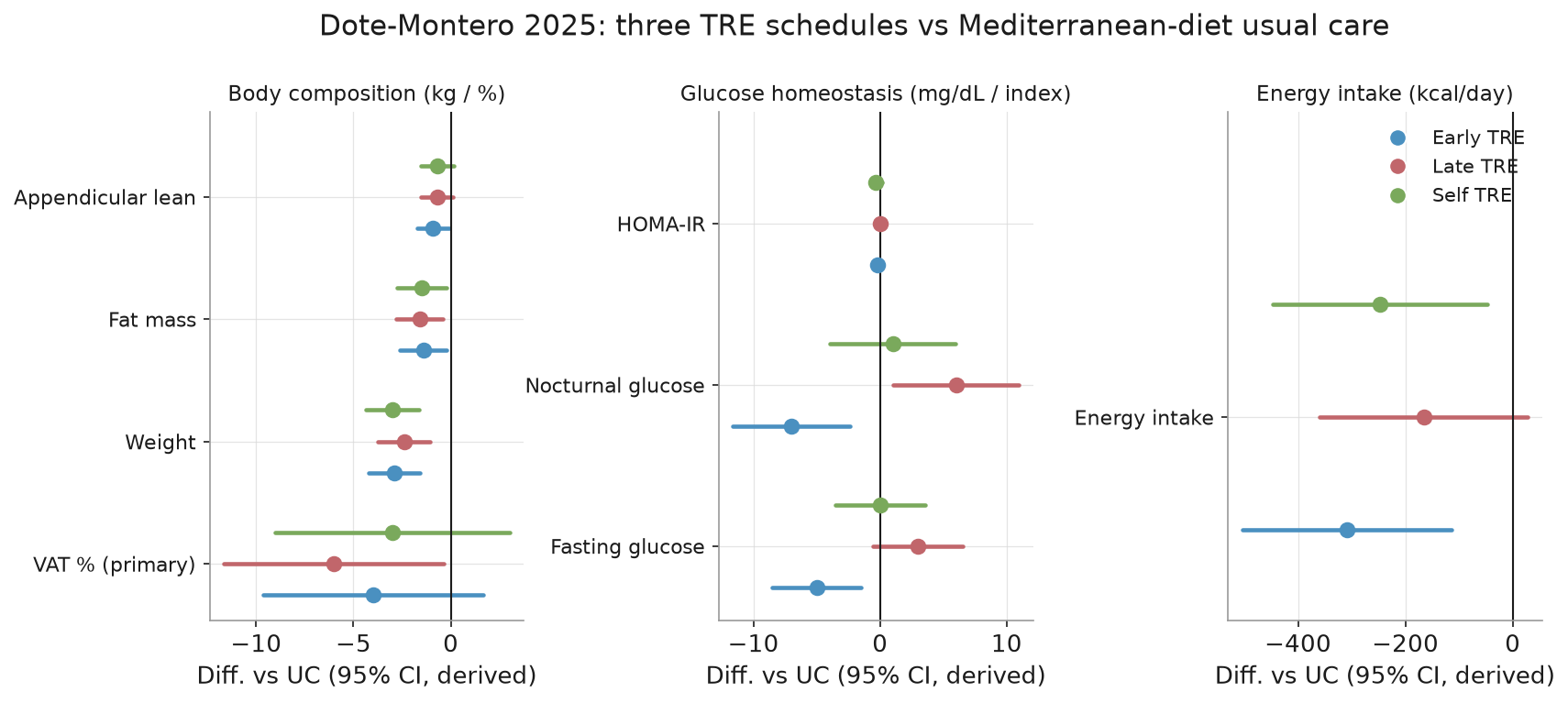
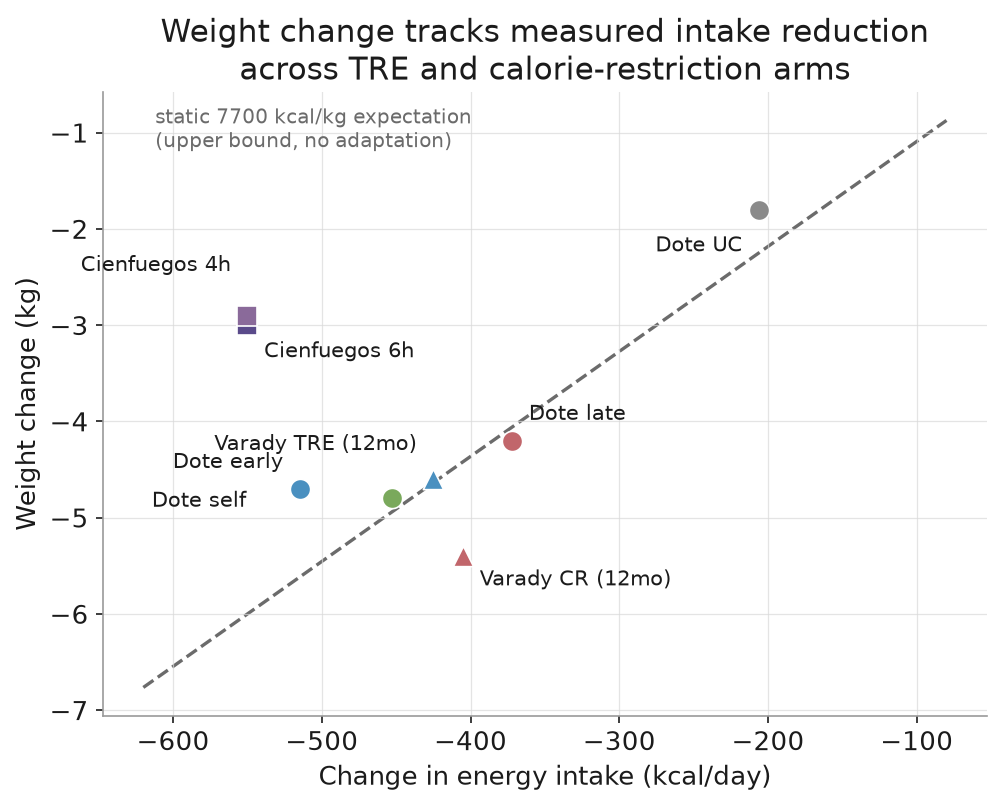
Secondary outcomes are not blank, though: TRE arms lost ~2.4–3.0 kg more than UC (within-group: UC −1.8 vs TRE −4.2 to −4.8 kg); 24-h recalls show spontaneous intake reductions of 372–515 kcal/day in TRE arms — while UC itself dropped 206, because Mediterranean-diet education also makes controls eat less. The weight difference and the eating-less difference point the same way at the same magnitude: every arm loses ~9–11 kg per 1000 kcal/day of intake reduction, the control arm included (8.7). Figure 1 plots arm-level intake change against weight change across trials: every point hugs the static 7700 kcal/kg expectation line, and no arm lands on the favourable side of the line because it was "fasting".
Adherence was high (85–88% window adherence across TRE arms); there were no serious adverse events (five mild ones). One noise source on record: female late-TRE participants reported a baseline intake of 1666 kcal/day, visibly below the other groups (~1900–2000) — a baseline imbalance layered on top of recall error, so intake numbers should be read for magnitude and direction, not precision.
The energy-matching test: what is left once "eating less" is controlled
If TRE's benefits are all attributable to eating less, then designs that control intake should show no further window benefit. Three pieces of evidence form exactly that test:
Active calorie-restriction comparator (Varady 2023, Annals of Internal Medicine): 90 adults with obesity randomized to ad libitum 8-h TRE (12:00–20:00), prescribed daily calorie restriction (CR), or control, for 12 months. Varady 2023 The result is almost tailor-made for our question: TRE cut intake spontaneously by −425 kcal/day, CR by prescription −405 — the two groups ate statistically indistinguishable amounts less, and lost statistically indistinguishable weight (−4.61 vs −5.42 kg vs control; TRE-vs-CR +0.81 kg, 95% CI −3.07 to 4.69, p=0.68). Compressing eating time and "eating this much less" produced the same result, with no detectable timing increment.
Restriction prescribed in both arms (Liu 2022, NEJM): 139 patients with obesity, both arms on prescribed calorie restriction, one adding an 8-h window (8:00–16:00), for 12 months. Liu 2022 Window-plus-restriction lost −8.0 kg, restriction alone −6.3 kg; net −1.8 kg (−4.0 to 0.4, p=0.11) — direction favourable, not significant, and this is the most direct measure of "adding a window on top of restriction".
Early window over weight-loss counselling (Jamshed 2022, Obesity): 90 adults with obesity, both arms receiving weight-loss counselling with energy-restriction advice, one adding an early 8-h window, for 14 weeks. Jamshed 2022 The window arm lost an extra −2.3 kg (−3.7 to −0.9, p=0.002) — significant this time, but the authors themselves convert the increment to "equivalent to about 214 kcal/day of additional reduction": even where a window does add weight loss, the added loss is explained by eating less still, at a magnitude consistent with the energy response — not a timing bonus. Read next to Liu: the window increment over restriction or counselling is −1.8 to −2.3 kg, inconsistently significant, and intake-mediated wherever it is measured.
Eucaloric controlled feeding (Sutton 2018, Cell Metabolism): eight men with prediabetes in a crossover trial ate only study-provided food at weight-maintenance calories, five weeks on an early window (6-h, dinner before 15:00) vs a 12-h window. Sutton 2018 Weight stayed stable in both arms — the only human trial that physically removes the "ate less" confound by design. The result: glucose itself unchanged, but fasting insulin −3.4 mU/L, mean insulin −26, peak −35, blood pressure −11/−10 mmHg, 8-isoprostane −14% — at zero weight change, meal timing still moved the insulin axis and blood pressure.
Read together: for weight and adiposity, once intake is controlled the window adds nothing detectable (Varady, Liu), and the one significant increment (Jamshed) is itself intake-mediated; for the insulin/blood-pressure axis, timing retains measurable effects even under eucaloric feeding (Sutton). Timing is not useless — its point of action is not "how much weight came off" but "in what metabolic context the same calories were processed".
The timing signal: real, but confined to the glycemic axis
The most informative part of the Dote-Montero trial is not its primary endpoint but its sex-stratified TRE-vs-TRE table — the paper's own published early-vs-late differences: [Figure 3]
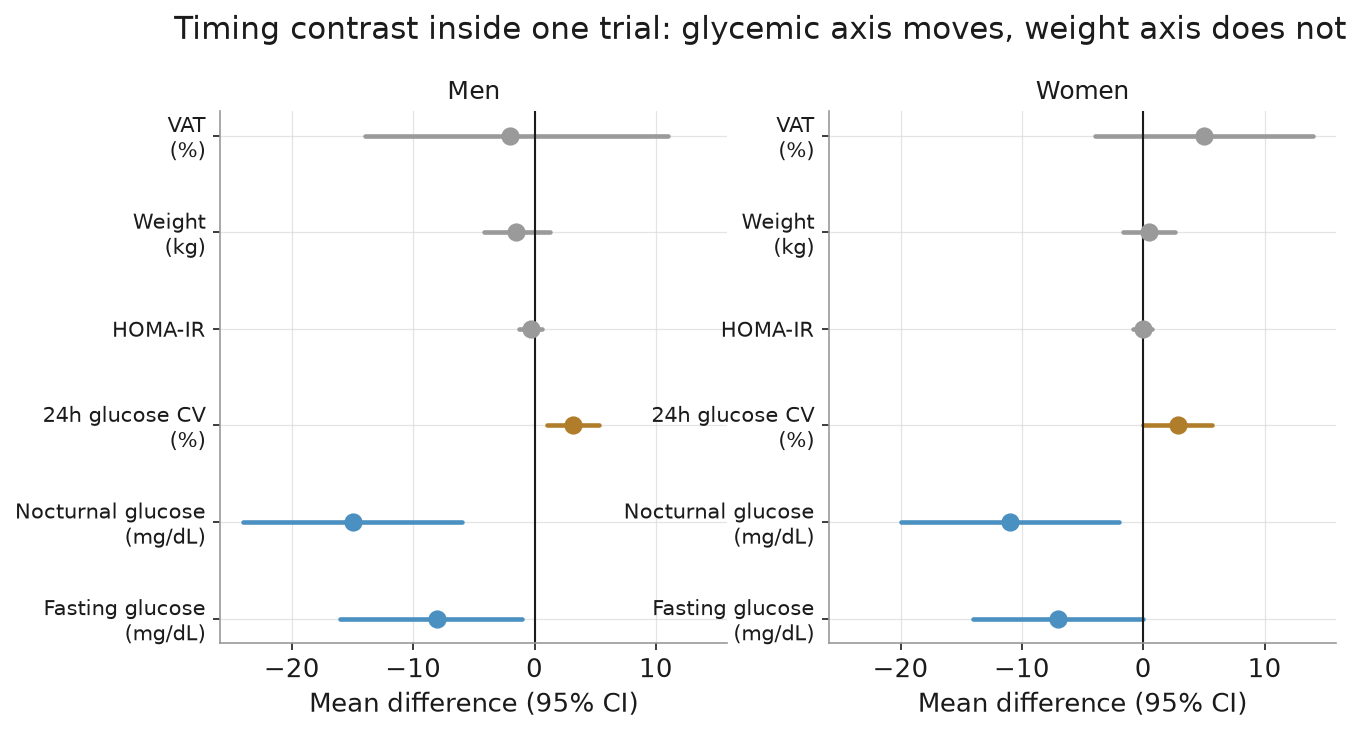
- Fasting glucose: men −8 (−16 to −1), women −7 (−14 to 0) mg/dL, nominally significant in both sexes;
- Nocturnal mean glucose (CGM): men −15 (−24 to −6), women −11 (−20 to −2) mg/dL, significant;
- Weight and VAT: arms completely indistinguishable;
- 24-h glucose variability: higher in the early arm (+3.2/+2.9 points, significant) — compressing eating into the morning did not smooth the whole day's glucose.
Same trial, same intervention length, same adherence: early beats late on the glucose axis consistently and per the paper's own numbers, while the weight and fat axes show zero difference. Xie et al. 2022 (90 healthy adults without obesity randomized, 82 analyzed, 5 weeks) gives an independent same-direction check: early-window HOMA-IR fell −1.08 while the midday window's rose +0.39 (p<0.001), with intake reductions indistinguishable between the two TRE arms (−240 vs −159 kcal/day, p=0.30). Xie 2022
Three honest caveats must follow:
- Nocturnal glucose has a mechanical explanation. Late-window participants finish eating around 21:00, so for part of the night the CGM is recording glucose still being absorbed — "higher overnight glucose" is partly bookkeeping of the window position, not all metabolic disadvantage. Fasting glucose (morning state, more comparable elapsed time since the last meal) is the cleaner readout, and it does favour early timing too.
- Elapsed fasting time at measurement differs. By the morning draw the early arm has fasted ~14–16 h, the late arm ~10–12 h — part of the fasting-glucose gap may be the acute effect of "having fasted a few hours longer", not steady-state metabolic improvement.
- All surrogates. These are 12-week glucose readings, not diabetes incidence, cardiovascular events, or lifespan. Sutton's insulin-sensitivity result likewise rests on eight men with prediabetes in a five-week crossover — directionally consistent, limited in reach.
The accurate statement about timing is therefore: a consistent early-window advantage exists on the glucose/insulin axis across trials, of moderate strength (surrogate endpoints, short duration, partly explainable confounds); on weight and fat distribution, no timing effect is detected.
Fasting duration: the dose curve is flat over the studied range
If fast length were itself a dose variable, shorter windows should outperform. The evidence says otherwise: [Figure 4]
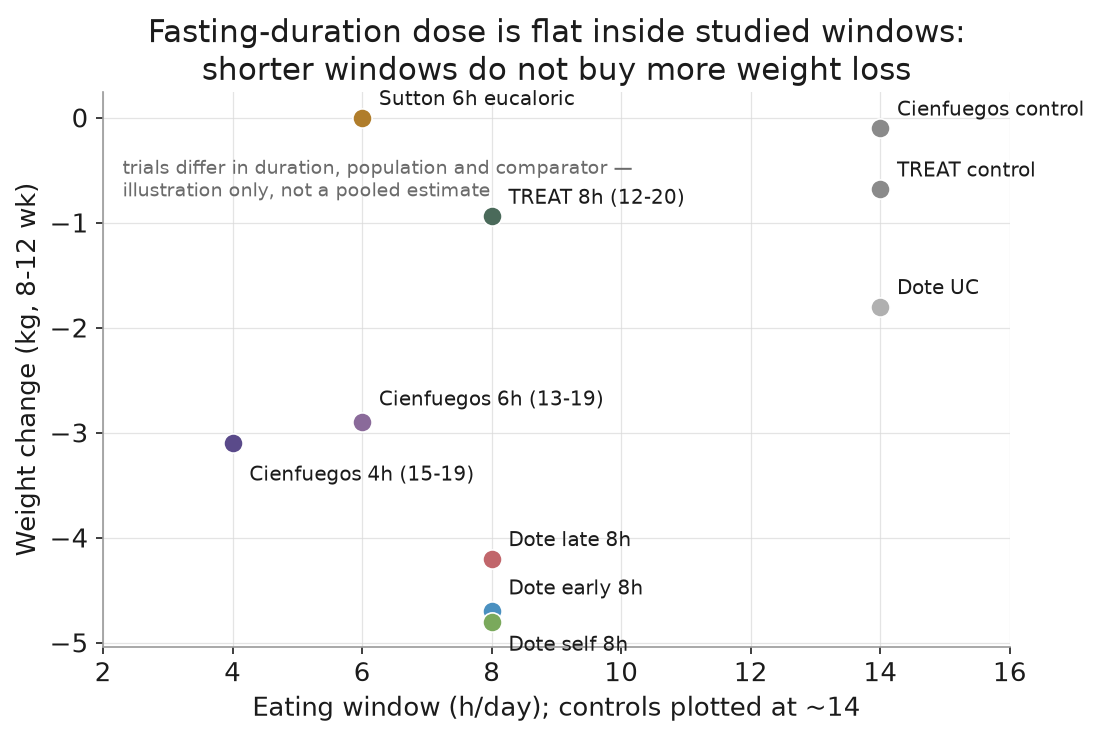
- Inside one trial: Cienfuegos et al. 2020 randomized adults with obesity to a 4-h window (15:00–19:00), a 6-h window (13:00–19:00), or control for 8 weeks. Cienfuegos 2020 The two arms cut intake almost identically (~550 kcal/day each) and lost the same ~3% — shaving two more hours off the window (18-h to 20-h fast) bought nothing extra.
- Across trials: weight change at 4-h (~−3.1 kg equivalent), 6-h (−2.9), and 8-h (−4.2 to −4.8 vs −0.94) windows scatters in a directionless way — the two 8-h trials differ by a factor of five because of population, comparator, and whether dietary education was included, not because of window length. Within the 16–20 h fasting range the dose-response is flat; windows shorter than 4 h or fasts longer than ~20 h were not tested in these adult RCTs, and nothing should be extrapolated there.
- Indirect corroboration: if duration were the driver, the early arm (dinner early, longer actual fast) should also beat the late arm on weight — it does not.
This does not rule out effects of fast length at longer scales or on other outcomes; it shows that within the studied daily-window range, "two more fasting hours" is not a measurable independent source of benefit.
Safety: well tolerated, with a lean-mass signal worth watching
Pooling the safety readouts: no serious adverse events in Dote-Montero (five mild), no material between-arm AE differences in Liu, adherence above 85% in several trials — as a dietary intervention TRE is genuinely tolerable and feasible.
The detail worth tracking is body composition: all three TRE arms lost 1.1–1.3 kg of appendicular lean mass over 12 weeks (within-group significant), vs −0.4 kg (ns) in controls; TREAT (16:8, 12 weeks) likewise reported an appendicular lean-mass index difference of −0.16 kg/m² (p=0.005) vs controls. Lowe 2020 Two independent trials, same direction on the same index. The reasonable reading is that weight loss always carries a lean fraction (TRE arms lost 2–3× the control's weight, and the lean share is not disproportionate) — but for older adults who specifically want to preserve muscle, this is a line item that must be kept separate when "weight loss" is booked as a benefit. Our evidence set contains no strength or functional outcomes, so whether this lean loss costs function cannot be judged here.
Layered verdict: what each variable earned
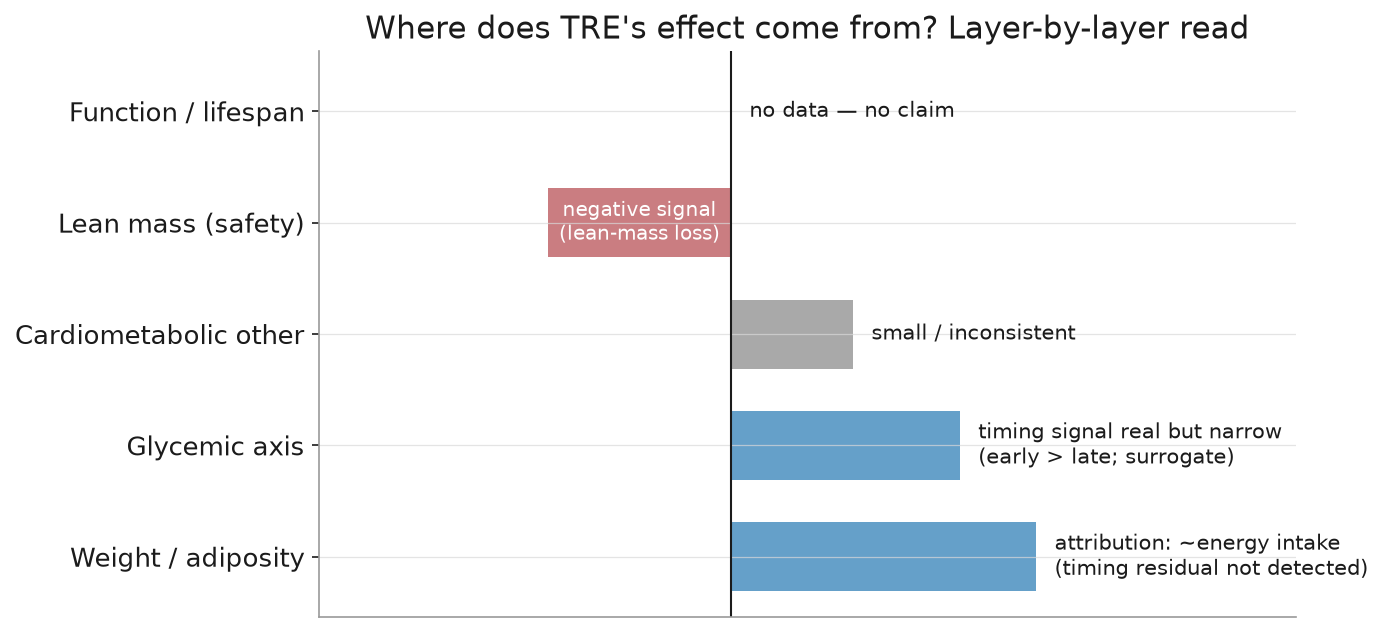
With all the evidence laid out by outcome layer, the answer is clear: [Figure 5]
| Outcome layer | Verdict | Strength |
|---|---|---|
| Weight / fat mass | Measurable benefit almost entirely attributable to spontaneous intake reduction; no timing or duration residual detected | moderate–high (consistent across trials) |
| Visceral fat (prespecified endpoint) | No window adds detectable benefit over Mediterranean-diet usual care | moderate (single large trial, but the strictest design) |
| Glucose/insulin axis | Direction-consistent early-window advantage; insulin sensitivity still improves under eucaloric feeding | moderate (surrogates, short term, partly mechanical confounds) |
| Other cardiometabolic (BP, lipids) | Small or inconsistent; Sutton's BP effect is the standout but n=8 | limited |
| Lean mass / safety | Consistent mild negative signal; functional meaning unmeasured | moderate |
| Function, disease, healthspan, lifespan | No data | absent — no claim made |
Back to the three-part question in the title, the division of credit is explicit:
- Eating less explains essentially all of the weight/adiposity benefit — that part is not an "extra" of fasting but the part fasting helps deliver;
- Timing has a real, direction-consistent but narrow effect on the glucose/insulin axis (early beats late), partly attributable to mechanics and elapsed fast — the residue is consistent with circadian physiology;
- Fasting duration has no measurable independent contribution within the 16–20 h/day range studied.
In other words, the phrase "fasting's extra benefit" needs rewriting: the bulk of the benefit is not extra — it is eating less; the timing contribution is real but narrow, landing on the glycemic axis; the duration contribution is nil over the tested range. Compressing those three layers into "intermittent fasting fights ageing" is precisely the compression this article was written to undo.
Limitations and applicability
- The load-bearing trial's main text is paywalled; core data come from its supplements, abstract, registry, and the same trial's open-access secondary publication (sleep/mood outcomes showed no harm signal from TRE). JAMA Netw Open 2025
- No individual-level data: between-group differences are arithmetic derivations or the paper's own sex-stratified values; energy intake rests on 24-h recalls, with the female late-TRE baseline imbalance flagged rather than adjusted away.
- Every comparison here tests "difference not detected" — the confidence intervals still admit small-to-moderate true effects; "not detected" is not "zero".
- Populations are adults with overweight/obesity or selected metabolic risk, over 12 weeks–12 months; older adults, patients with diabetes, and long-horizon outcomes fall outside this conclusion. The only longer-horizon readout is the same trial's 12-month maintenance follow-up (n=99 subsample): early and late TRE maintained greater weight loss vs UC, with 26% still reporting TRE at follow-up — a same-trial supplementary layer, not independent replication Clin Nutr 2026.
- Animal-mechanism literature (autophagy, substrate switching) is used only as a boundary statement, not folded into effect estimates.
Provenance and updates
This study was completed by Devin (agent); the self-review was performed by the same agent and is not independent review. The evidence archive (supplements, PMC full texts, abstracts, registry record, legacy-site snapshot) with its SHA256 manifest lives in evidence/fasting-timing-energy/; transcribed inputs and all analysis code are in research/calculations/fasting-timing-energy/ (trial_data.py annotates every cell's table location); the reproduction bundle reproduce.zip and public figures are in research/assets/fasting-timing-energy/. Formal self-review, score, and editorial sign-off are recorded in the research record.
Sources
- <a id="source-s1"></a>Dote-Montero M et al. Effects of early, late and self-selected time-restricted eating on visceral adipose tissue and cardiometabolic health in participants with overweight or obesity: a randomized controlled trial. Nat Med 2025;31:524–533. (abstract + all supplements; main text paywalled) PMID 39775037
- <a id="source-s2"></a>ClinicalTrials.gov NCT05310721 record (primary endpoint: 12-week VAT change by MRI)
- <a id="source-s3"></a>Dote-Montero M et al. Trial protocol: Efficacy of different 8 h time-restricted eating schedules… Nutr Metab Cardiovasc Dis 2024;34:177–187. (abstract level)
- <a id="source-s4"></a>Varady KA et al. Time-Restricted Eating Without Calorie Counting for Weight Loss in a Racially Diverse Population. Ann Intern Med 2023. (PMC full text PMC11192144)
- <a id="source-s5"></a>Liu D et al. Calorie Restriction with or without Time-Restricted Eating in Weight Loss. N Engl J Med 2022;386:1495–1504. (abstract level, paywalled)
- <a id="source-s6"></a>Sutton EF et al. Early Time-Restricted Feeding Improves Insulin Sensitivity, Blood Pressure, and Oxidative Stress Even without Weight Loss in Men with Prediabetes. Cell Metab 2018;27:1212–1221. (PMC full text PMC5990470)
- <a id="source-s7"></a>Xie Z et al. Randomized controlled trial for time-restricted eating in healthy volunteers without obesity. Nat Commun 2022;13:1003. (PMC full text PMC8864028)
- <a id="source-s8"></a>Cienfuegos S et al. Effects of 4- and 6-h Time-Restricted Feeding on Weight and Cardiometabolic Health. Cell Metab 2020;32:366–378. (PMC full text PMC9407646)
- <a id="source-s9"></a>Lowe DA et al. Effects of Time-Restricted Eating on Weight Loss and Other Metabolic Parameters: The TREAT Randomized Clinical Trial. JAMA Intern Med 2020;180:1491–1499. (abstract + PMC record PMC7522780)
- <a id="source-s10"></a>Secondary analysis of the same trial: Time-Restricted Eating and Sleep, Mood, and Quality of Life. JAMA Netw Open 2025;8:e2517268. (PMC full text PMC12199060; same trial — not independent evidence)
- <a id="source-s11"></a>Jamshed H et al. Early Time-Restricted Feeding Improves 24-Hour Glucose Levels and Affects Markers of the Circadian Clock, Aging, and Autophagy. Nutrients 2019;11:1234. (PMC full text PMC6627766; mechanistic context)
- <a id="source-s12"></a>Jamshed H et al. Effectiveness of Early Time-Restricted Eating for Weight Loss, Fat Loss, and Cardiometabolic Health. Obesity 2022. (abstract + PMC record PMC9361187; replication layer)
- <a id="source-s13"></a>12-month maintenance follow-up: Effects of early, late, and self-selected TRE on weight loss maintenance… Clin Nutr 2026;63:106706. (abstract level; n=99 subsample of the same trial — not independent evidence)
Scope & limitations
- The load-bearing main text (Dote-Montero 2025, Nat Med) is paywalled - core data come from its supplements, abstract, registry, and the same trial's open-access secondary publication; the access level is honestly downgraded (c1-c4).
- No individual-level data: between-group differences are arithmetic derivations (independent-variance propagation) or the paper's own sex-stratified values; covariate adjustment and interaction tests are impossible (c1-c3).
- Energy intake rests on 24-h recalls, noisy and with a baseline imbalance (female late-TRE 1666 kcal/d) - used for direction and magnitude only (c2).
- Every 'difference not detected' interval still admits small-to-moderate true effects; the nocturnal-glucose difference carries a mechanical component and the fasting-glucose difference an elapsed-fast component (c4).
- The timing and duration comparators differ in population, duration, and control conditions (from an n=8 eucaloric crossover to the n=197 trial) - cross-trial reading is direction-consistency only, with no pooled estimate (c5, c6).
- All outcomes are surrogates over <=12 months; there are no functional, disease, healthspan, or lifespan data (c8).
Sources
- Dote-Montero M et al. Early, late and self-selected time-restricted eating vs usual care in overweight/obesity. Nat Med 2025;31:524–533
paper · Source version: 2025; DOI 10.1038/s41591-024-03375-y; supplements MOESM1/2 via Springer static links, 2026-09-19
Reading scope
Relevant sections
Main text paywalled (non-OA, no PMCID, nature.com blocked); abstract + registry + 18-page supplements cover all core data including the prespecified primary endpoint and energy intake. Access honestly labelled supplements+abstract.
- Abstract: arms n=49/49/52/47; VAT MD −4/−6/−3% (P≥0.31); TRE-vs-TRE P≥0.99; adherence 85-88%; 5 mild AEs
- Suppl Table 1: within-group means (95%CI) all endpoints incl. energy −206/−515/−372/−453 kcal/d, weight −1.8/−4.7/−4.2/−4.8 kg
- Suppl Table 5: sex-stratified early-vs-late published MDs — fasting glucose −8*/−7*, nocturnal −15*/−11*, 24hCV +3.2*/+2.9*
- ClinicalTrials.gov NCT05310721 registration record
registry · Source version: API v2 JSON snapshot 2026-09-19
Reading scope
Bibliographic record only
Registry JSON read directly; confirms prespecified primary outcome = 12-week VAT change by MRI, matching the publication — no endpoint drift detected.
- Status COMPLETED, actual enrollment 197
- Primary outcome: change in visceral adipose tissue at 12 weeks by MRI
- Dote-Montero M et al. Trial protocol, Nutr Metab Cardiovasc Dis 2024
paper · Source version: 2024; DOI 10.1016/j.numecd.2023.09.014
Reading scope
Abstract
Abstract level; used to confirm the prespecified three-window design.
- Abstract: protocol registering early/late/self-selected windows and VAT primary endpoint
- Varady KA et al. TRE without calorie counting vs daily CR vs control, Ann Intern Med 2023
paper · Source version: PMC full text downloaded 2026-09-19
Reading scope
Full text
Full text read. The active-CR-comparator load-bearing trial: at equal intake reduction the window adds no weight benefit.
- Results: intake −425(SD531) TRE vs −405(SD712) CR kcal/d; weight vs control −4.61 vs −5.42 kg; TRE−CR +0.81(−3.07,4.69) P=0.68
- 90 randomized, 77 completed, 12 months, 8-h window 12:00–20:00
- Liu D et al. Calorie restriction with or without TRE, NEJM 2022
paper · Source version: 2022; DOI 10.1056/NEJMoa2114833
Reading scope
Abstract
Abstract level (paywalled). Prescribed CR in both arms — the most direct measure of adding a window on top of restriction.
- Results: −8.0 vs −6.3 kg; net −1.8(−4.0,0.4) P=0.11; 139 randomized, 118 completed
- Sutton EF et al. eTRF improves insulin sensitivity and BP without weight loss, Cell Metab 2018
paper · Source version: PMC full text downloaded 2026-09-19
Reading scope
Full text
Full text read. The only human trial that physically removes the ate-less confound by design — timing effects persist at zero weight change on the insulin/BP axis.
- Design: 5-wk crossover, eucaloric controlled feeding, 6-h window vs 12-h, n=8 completers
- Results: fasting insulin −3.4±1.6; mean insulin −26±9; SBP −11±4/DBP −10±4; 8-isoprostane −14%; weight stable both arms
- Xie Z et al. eTRF vs mTRF vs control in healthy non-obese adults, Nat Commun 2022
paper · Source version: PMC full text downloaded 2026-09-19
Reading scope
Full text
Full text read. Independent replication: early beats midday on insulin resistance at indistinguishable intake reduction.
- HOMA-IR: eTRF −1.08±1.59 vs mTRF +0.39±0.71 (P<0.001)
- Intake: eTRF −240 vs mTRF −159 kcal/d, between-TRF P=0.30
- Cienfuegos S et al. 4-h vs 6-h TRF vs control, Cell Metab 2020
paper · Source version: PMC full text downloaded 2026-09-19
Reading scope
Full text
Full text read. The duration-dose load-bearing trial: 18-h vs 20-h fasts are indistinguishable.
- Both arms: ~550 kcal/d reduction, ~3% weight loss at ~98 kg baseline; 8 weeks
- Lowe DA et al. TREAT randomized trial, JAMA Intern Med 2020
paper · Source version: 2020; DOI 10.1001/jamainternmed.2020.4153
Reading scope
Abstract
Abstract + PMC record level. Source of the null weight result and the lean-mass safety signal.
- Results: −0.94 vs −0.68 kg, between −0.26 P=0.63; appendicular lean index −0.16 kg/m² P=0.005
- Sleep/mood/QoL secondary analysis of the same trial, JAMA Netw Open 2025
paper · Source version: EuropePMC full-text XML 2026-09-19
Reading scope
Full text
Full text read; registered as a same-trial supplementary layer, not counted as independent evidence.
- Design details (no calories outside window, app adherence logging); no TRE harm on sleep/mood/QoL
- Jamshed H et al. eTRF and circadian/autophagy markers, Nutrients 2019
paper · Source version: PMC full text downloaded 2026-09-19
Reading scope
Full text
Full text read as mechanistic context; no human autophagy-onset inference drawn from it.
- eTRF 24-h glucose improvement and circadian/autophagy marker expression
- Jamshed H et al. eTRE weight-loss trial, Obesity 2022
paper · Source version: 2022; PMC record PMC9361187
Reading scope
Abstract
Abstract level. Third energy-matching load-bearing trial: the only significant window increment is itself intake-mediated.
- Results: both arms received weight-loss counselling + ER advice; eTRE+ER vs CON+ER −2.3 kg (−3.7,−0.9, P=0.002); fat −1.4 kg ns; authors equate increment to +214 kcal/d; DBP −4 mmHg; n=90, 59-completer secondary analysis, 14 wk
- 12-month weight-maintenance subsample of the same trial, Clin Nutr 2026
paper · Source version: 2026; DOI 10.1016/j.clnu.2026.106706
Reading scope
Abstract
Abstract level; same-trial maintenance subsample (n=99) registered as a supplementary layer.
- Early (P=0.01) and late (P=0.02) TRE maintained greater weight loss vs UC; 26% still reported TRE at follow-up
Authorship & review
Author self-review · Devin (AI agent)
2026-09-19 · The author's own focused review of the whole article, performed by the same agent: agreement between the main question (attribution of TRE benefits under energy-matched conditions - eating less / timing / fasting duration) and scope; actual reading depth of load-bearing sources (Dote-Montero 2025 abstract + all supplements + registry + protocol, PMC full texts for Varady/Sutton/Xie/Cienfuegos/JAMA secondary, abstract or PMC-record level for Liu/TREAT/Jamshed 2019/Jamshed 2022/Clin Nutr); whether the analysis plan was locked before use; cell-by-cell checking of every load-bearing number against trial_data.py transcriptions and output CSVs; adjudication of four competing paths (energy / timing / duration / fasting-specific programmes) using active-CR, eucaloric, timing-arm, and duration-arm comparators; statistical calibration (no individual data, arithmetic-derivation between-group values, nominal p, 24-h recall noise, baseline imbalance); retention of unfavourable and boundary evidence (all-null VAT primary, higher early-arm 24-h glucose CV, consistent appendicular lean-mass loss, the intake-mediated Jamshed increment, absent lifespan/function layers); translation consistency and overstated claims; safety boundary (no dietary regimen or medical advice). Method: mechanical checks first (zero CJK in the English file, identical anchors and figure numbers), then every load-bearing number against the output files, then paper quotations re-verified, then a 0-10 self-score; one revision round preceded the final rating.
Remaining limitations:
- This self-review was performed by the same agent that authored the article; it is not an independent, human, or professional review.
- The load-bearing main text is paywalled: Dote-Montero 2025's full text was not read; core data come from abstract + all supplements + registry + the same trial's OA secondary paper, and the access level is honestly downgraded - any divergence between main-text methods and supplements would go undetected.
- No individual-level data: between-group differences are arithmetic derivations or the paper's sex-stratified values; 'not detected' intervals still admit small-to-moderate true effects.
- Energy intake is 24-h recall self-report with a baseline imbalance in the female late-TRE arm - attribution can only show consistency, not causal share.
- Not a systematic review: the comparator set was selected by design feature (active CR / eucaloric / timing arms / duration arms), not exhaustive of all TRE trials; meta-analyses were not used as load-bearing evidence.
Editorial approval · Devin (AI agent)
2026-09-19 · Editorial sign-off executed by the same agent that authored the article, explicitly in a different working role - not independent, human, or professional review. Checked against the publication-blocking list: (1) source identity and versions - Dote-Montero abstract+supplements+registry, PMC full texts for Varady/Sutton/Xie/Cienfuegos/JAMA secondary, abstract-level bibliographies verified one by one; evidence SHA256-archived (30 items); (2) no conclusions contrary to the sources - all-negative VAT primary endpoint, higher early-arm 24-h glucose CV, consistent appendicular lean-mass loss, TREAT null weight result, and the intake-mediated Jamshed increment are all retained; (3) denominators and statistical objects - arm sizes, randomized-vs-analyzed n, arithmetic-derivation between-group values, nominal p, 24-h recall noise, female late-TRE baseline imbalance all stated; (4) no model assumptions used to prove reality - the energy-response line is a consistency check not a causal-share proof, no individual data, derivation interval differences disclosed; (5) safety gaps - no dietary regimen/window/duration advice, applicability boundaries stated; (6) publication scope is evidence description - no professional review trigger. Covers the current English version.
Translation check · Devin (AI agent)
· The same agent wrote the English text from the same evidence record rather than translating sentence by sentence, then compared it section by section against the Chinese. Checked: identical statistics (VAT MDs -4/-6/-3% P=0.87/0.31/>=0.99; weight -4.7/-4.2/-4.8 vs -1.8, derived between -2.4 to -3.0; intake -515/-372/-453 vs -206, derived -166 to -309; kg per 1000 kcal/d 8.7-11.3; Varady -425/-405 +0.81 P=0.68; Liu -8.0/-6.3 -1.8 P=0.11; Jamshed -2.3 P=0.002 +214 kcal/d; Sutton -3.4/-26/-35, -11/-10 mmHg, ~14%; early-vs-late -8/-15 men, -7/-11 women, CV +3.2/+2.9; Xie -1.08/+0.39 P<0.001, intake P=0.30; Cienfuegos ~550/~3%; TREAT -0.94/-0.68 -0.26 P=0.63, ALMI -0.16 P=0.005; appendicular lean -1.1 to -1.3 vs -0.4; Clin Nutr n=99 P=0.01/0.02 26%); every qualification preserved (paywall access level, arithmetic derivations, nominal p, mechanical nocturnal-glucose component, elapsed-fast confound, appendicular lean-mass signal, absent lifespan/function layers, no dietary advice); source anchors s1-s13 and all five figure embeds identical between languages; zero CJK characters in the English file.
Funding & interests
None. This article is a recomputation of published group-level summaries plus an evidence-layering exercise.
Funding of cited research
Dote-Montero 2025 corresponding author J.R.R. reports lecture fees from Novo Nordisk and Abbott (areas unrelated to this study); the remaining authors report no conflicts. Disclosed as relevant context.