Our answer first
"Younger" holds at the molecular-readout layer, but the real magnitude is smaller, far more variable, and clock-version sensitive than the headline: 4–5 weeks after withdrawal, the median Horvath1 methylation-age offset of transiently reprogrammed cells versus same-day controls is about −9 years, with a per-sample range of −37 to +17 years and a donor×day range of −30.3 to +9.3; only fibroblast/skin-trained clocks move — blood-trained Hannum and PhenoAge and the stem-division clock EpiTOC are flat. A deeper confound: methylation clocks substantially track the dedifferentiation process itself — during exposure, clock readings co-move with identity-axis position (Spearman r = −0.33, p = 0.007), i.e. the clock is partly a "reprogramming-progress meter". At the identity layer the answer is "largely reacquired, not bit-perfect": fibroblast markers are fully restored, but a +0.25–0.30 SD residual elevation of the pluripotency score persists after withdrawal — and the same residual appears in the "exposed but failed to reprogram" arm, making it a shared OSKM-exposure scar rather than a rejuvenation signature. The function layer does not exist in this dataset: GEO carries no functional assays, and the paper-level scratch-migration result was variable across cells and — by the paper's own report — uncorrelated with the clock readings. The safety layer has no tumour, karyotype, or long-term endpoints; the harm boundary comes from the in-vivo literature: sustained OSKM produces teratomas, premature termination of reprogramming drives cancer, hepatic/intestinal expression causes premature death. Calling partial reprogramming "proven rejuvenation" exceeds the evidence; calling it "merely a measurement artefact" ignores the combination of a residual post-withdrawal clock offset and restored identity — the most defensible statement is that a population of cultured cells shifted several molecular readouts in a younger direction while largely retaining identity, with a central magnitude of a few to ~20 years rather than "30", and with the functional and human-meaning extrapolation still unestablished.
| What we did | What we got | What it cannot answer |
|---|---|---|
| Downloaded all processed matrices of GSE165180 (4 subseries) with SHA256 | Per-sample metadata for 96 methylation + 95 RNA samples: 3 donors × 3 conditions × 4 exposure lengths × during/post-withdrawal phases | Author-processed betas and Log2 RPM — not raw idat/FASTQ; no functional assays, karyotype, or per-cell pairing |
| Implemented 5 methylation clocks from biolearn coefficients | Per-sample estimates: Horvath1 (334/353 CpGs), Horvath2 skin+blood (391/391), Hannum (65/71), PhenoAge (513/514), EpiTOC (354/385) | The paper's implementation includes Horvath gold-standard normalization and an adult-age convention; we interpret within-dataset contrasts only, not absolute cross-study ages |
| Built an identity axis from 13 fibroblast + 12 pluripotency marker genes, anchored on Sendai fibroblasts (=0) and d54 SSEA4+ iPSC endpoints (=1) | Identity axis rises to 0.76–1.08 during exposure, returns to a median of 0.30 vs control 0.26 after withdrawal; fibroblast markers fully restored | Marker scores are analyst-defined exploratory metrics, not validated identity assays; single-cell identity heterogeneity is invisible |
| Cross-modal alignment at group level (donor×day×condition medians, not per-cell pairing) | Spearman(Horvath1, identity axis) = −0.33, p = 0.007 (68 group-level cells): clock readings fall as dedifferentiation advances | RNA and methylation come from different cell batches; individual-level joint trajectories are not provable |
| Failed-arm / negative-control decomposition | Post-withdrawal clock offsets (Horvath1): reprogrammed median −8.6 y, failed −4.1 y, control 0 (on Horvath2 the failed-arm median is ≈0 with ±25 y spread); pluripotency residual +0.25/+0.29 SD in both exposed arms | "Failed" is a sorting-marker designation; the failed arm cannot separate exposure effects from inefficient reprogramming |
| Mapped in-vivo harm evidence and field context | Abad 2013 teratomas, Ohnishi 2014 cancer after premature termination, Parras 2023 hepatic/intestinal premature death, Mosteiro damage/senescence signals required; Lu 2020 OSK long-term induction without reported tumours, Ocampo 2016 lifespan extension in progeroid mice | In-vivo literature read at abstract level; no extrapolation chain from in-vitro readings to human benefit |
Scope is limited to what this public dataset can arbitrate at each evidence layer. This article describes evidence and provides no reprogramming protocol, dosing, or operational guidance; OSKM, doxycycline, and exposure durations appear only as facts of the study's registered design and GEO metadata.
First, split "younger" into four layers
The headline conflates at least four separable meanings of "young", each of which can hold or fail independently in this kind of experiment:
- Readouts: do molecular "age meters" — methylation clocks, transcriptome clocks — read lower? This is where the "~30 years" claim lives.
- Identity: is the cell still a fibroblast? Reprogramming is identity rewriting by definition — "younger" and "became a different cell" must be judged separately.
- Function: does the cell do its job better — migration, matrix secretion, stress response? That is what "young" means biologically.
- Stability & safety: does the state persist, and at what cost (uncontrolled dedifferentiation, tumour risk, genomic damage)?
Four competing explanations of "younger" need arbitration:
- A. Local state restoration: cells reset molecular state to a younger position while retaining identity — the paper's reading, and the version the "rejuvenation" narrative needs.
- B. Dedifferentiation: cells simply travel toward pluripotency and clock reversal is a by-product — full reprogramming to iPSC zeroes the methylation clock, but that is "becoming embryo-like", not "rejuvenation".
- C. Selection / proliferative replacement: the measured "young cells" may be a subpopulation that retained a younger state or was enriched by sorting, not cells that each became younger. The failed and negative-control arms arbitrate this.
- D. Measurement-algorithm response: clocks are linear models over specific CpGs — if reprogramming rewrites those loci, readings move because "the algorithm is sensitive to reprogramming", not because "biological age" changed. Tests: do multiple clock versions agree, and are clock readings coupled to dedifferentiation position?
Gill's design happens to put all four explanations on data: it contains both "during-exposure intermediate" and "4–5-week post-withdrawal final" phases, a negative control plus an "exposed but failed" arm, and iPSC references.
Data and calibration: what can and cannot be computed
GSE165180 is the SuperSeries for the Gill study, with four subseries: GSE165176/178 are the full Sendai reprogramming trajectory (RNA + methylation), and GSE165177/179 are the MPTR transient-reprogramming experiment at the core of this article (RNA + methylation). In MPTR, fibroblasts carrying a doxycycline-inducible polycistronic OSKM cassette are exposed for 10/13/15/17 days, sorted by surface markers into "successfully reprogrammed" (CD13−/SSEA4+) and "failed" (CD13+/SSEA4− — expressed the reprogramming cassette but never SSEA4) populations alongside a mock-treated negative control, then cultured without inducer for 4–5 weeks before measurement. Gill 2022 GSE165180
Three calibration facts first:
- The independent biological unit is 3 donors (O1/O2 = 53 y, O3 = 38 y), not 96 samples. Each condition×day cell holds only n = 2–6 samples, and donor composition is unbalanced across days: the 13-day reprogrammed group contains only O2+O3 (n = 4), the 15-day group only O3 (n = 2) — the paper's "optimal 13–15-day window" is partly made of donor composition, which we return to below.
- Cross-modal alignment is group-level only. Methylation and RNA were measured on different cell batches; they share donor×day×condition group labels, not cell identity — we analyze group medians jointly and make no per-cell pairing claims.
- Clock implementations are version-sensitive. The input matrix is the authors' NOOB-normalized EPIC betas; Horvath1 loses 19 CpGs on this array (noted by the paper itself; our coverage audit confirms 334/353), which we impute with row means; the paper's implementation also applies Horvath gold-standard normalization. All interpretation is therefore restricted to within-dataset contrasts and directions — no absolute cross-study age claims. Clock implementation
Readout layer: the clock does rewind — conditionally
During exposure: the clock falls monotonically with dedifferentiation
Intermediate (pre-withdrawal) samples show a clean relation: the longer the OSKM exposure, the lower the methylation age and the closer the identity axis moves toward the iPSC endpoint. In the reprogrammed arm, Horvath1 falls from ~37 y at day 10 to ~16 y at day 17, and Horvath2 from ~27 to ~11; the identity axis's per-day medians sit at 0.78–0.98 over the same window, highest at the last day (per-sample range 0.76–1.08). Neither line moves in the control arm. The iPSC reference reads ~0 years — the clock direction itself is correct: complete reprogramming does zero it. [Figure 1]
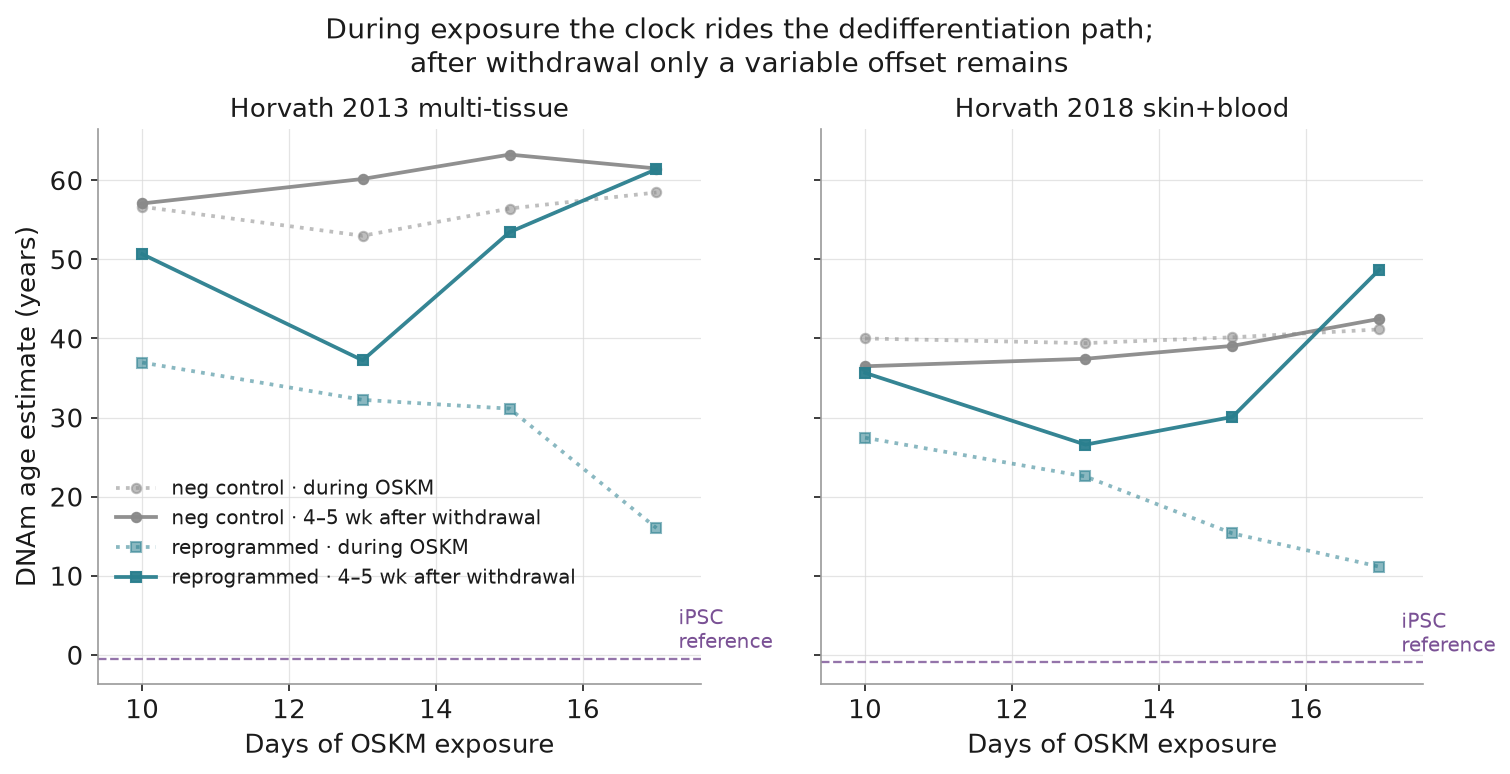
But this decline does not require "rejuvenation" as its explanation: cells on the iPSC trajectory show falling clock readings as a matter of course — the paper itself uses the full-reprogramming trajectory to locate when the reversal accrues (Figure 1A: a cumulative ~20 y reversal by day 10 and ~40 y by day 17), not to claim the during-exposure readings as the post-withdrawal MPTR result.
After withdrawal: a real but highly variable residual offset
The discriminating observation is the final-phase samples, taken 4–5 weeks after withdrawal — when cells are off inducer and morphology and markers have largely returned to fibroblast. Whatever offset remains on the clock is the candidate evidence for persistent rejuvenation. There is one — but it is far more conservative than the headline:
- Per-day median offsets (reprogrammed − same-day control): day 10 −6.4 y, day 13 −22.9 y, day 15 −9.8 y, day 17 −0.1 y (Horvath1).
- Per-sample range: −36.6 to +16.8 y (Horvath1); donor×day range −30.3 to +9.3 y (Horvath1) and −33.7 to +19.0 y (Horvath2) — there are post-withdrawal cells that read older (Horvath1, donor O2, 17-day arm median +9.3 y vs control).
- Pooled medians: reprogrammed −8.6 y, failed −4.1 y, control 0 (Horvath1). The failed-arm offset is version-sensitive too: on Horvath2 its median is ≈0 with a per-sample spread of ±25 y. [Figure 5]
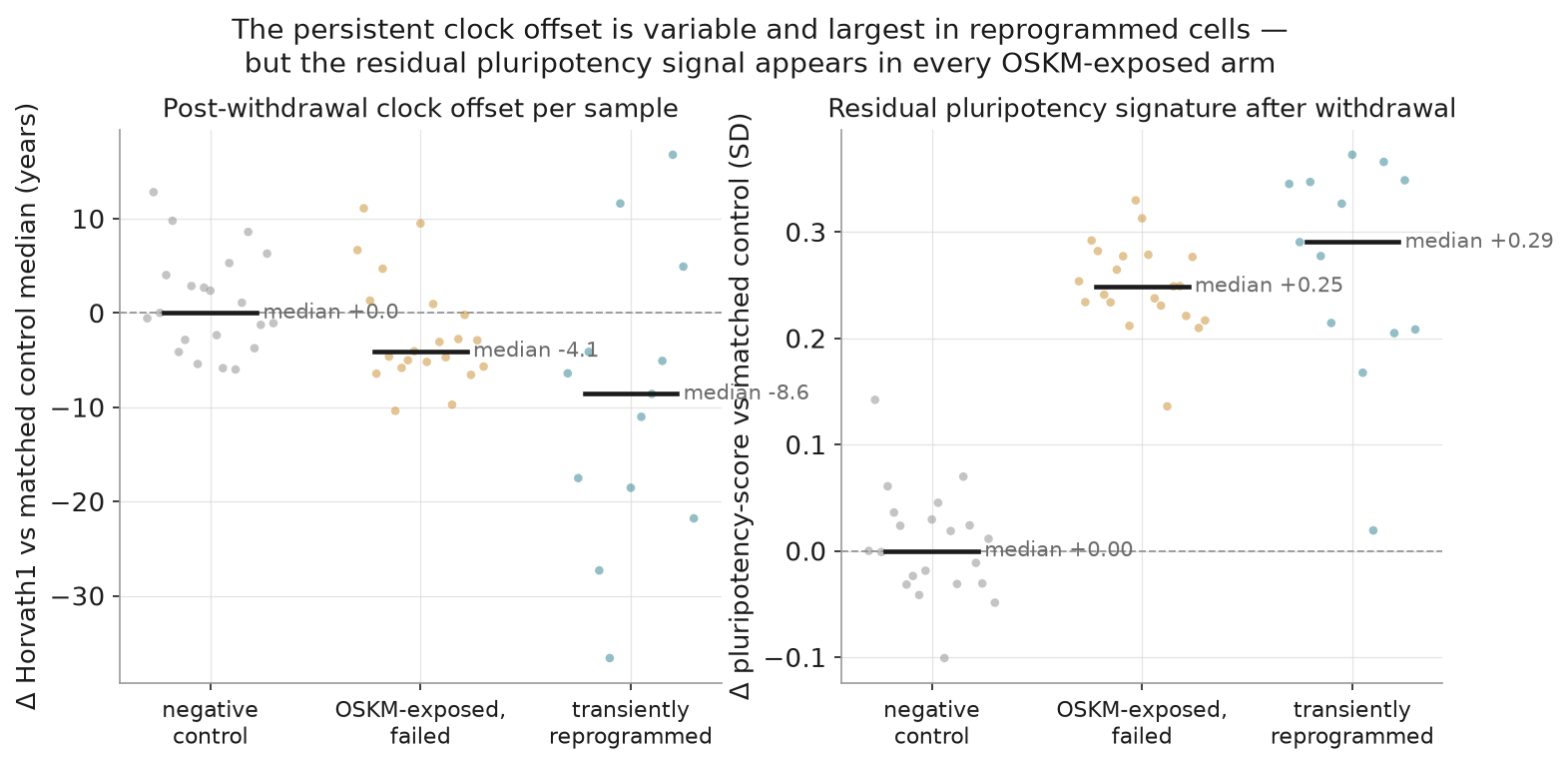
The paper's "~30 years" corresponds to the favourable end of this distribution (deepest per-sample offset −37 y; deepest donor×day is −33.7 y on Horvath2, in donor O1's 17-day cell) plus its bespoke transcriptome clock — not the central tendency. And since the day-13 group contains only O2+O3 and day-15 only O3, the "optimal window" is entangled with donor composition — the data cannot separate "day 13 is truly optimal" from "these two donors happened to respond strongly in that cell".
Version sensitivity: only fibroblast-trained clocks move
Of five clocks, only two — Horvath1 (multi-tissue) and Horvath2 (skin+blood) — show consistent post-withdrawal offsets; blood-trained Hannum and PhenoAge and the mitotic clock EpiTOC are flat or inconsistent. [Figure 2]
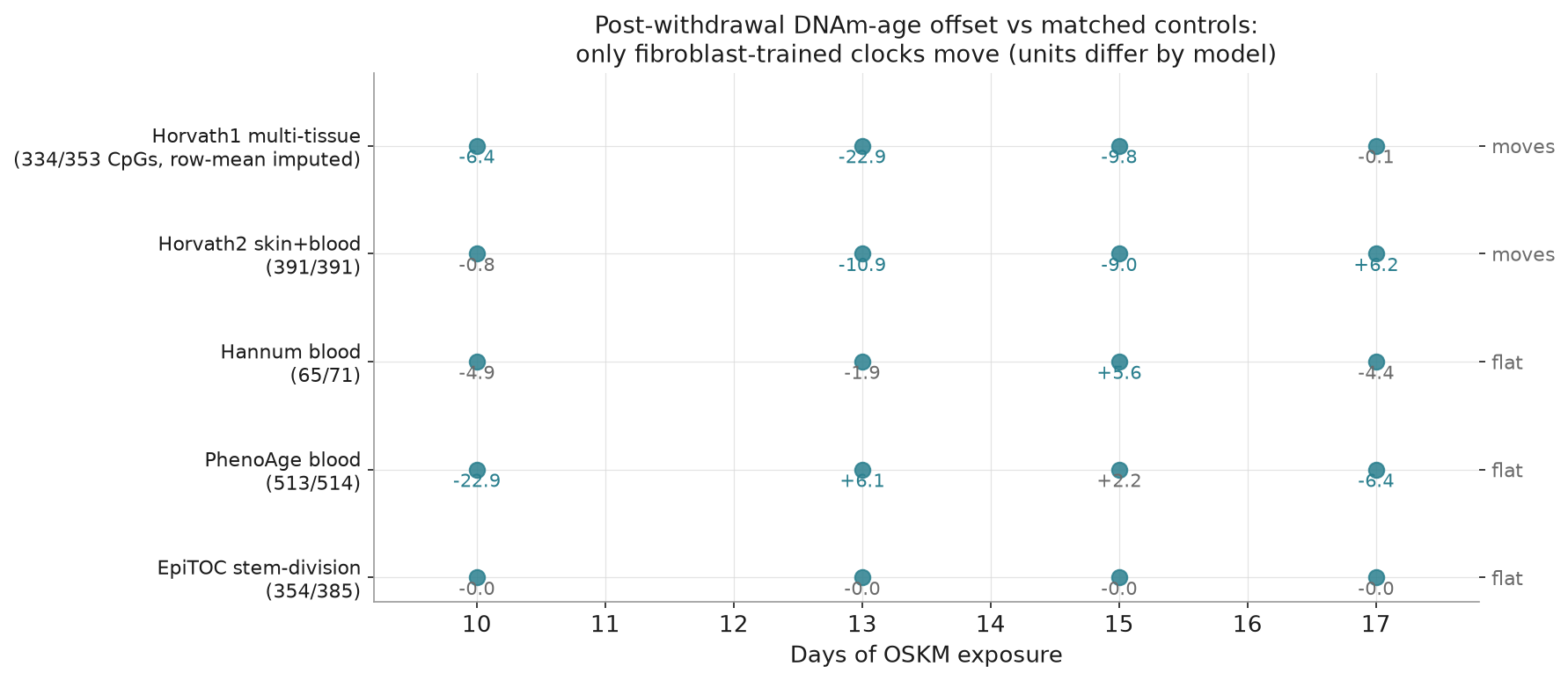
The paper itself notes this ("these other epigenetic clocks were not trained on fibroblast data"), but the caveat is lost in transmission: the widely quoted line is "methylation age reversed 30 years", not "only the two skin/fibroblast-relevant clocks move, with per-cell variability". Version sensitivity does not negate the change — it bounds where it holds: "methylation age" in this dataset is not one number but a set of model-specific numbers, of which only the skin/fibroblast-adjacent ones move.
Identity layer: toward iPSC, then largely back — with a scar shared by both exposed arms
Averaging z-scores of 13 fibroblast markers (COL1A1, COL3A1, DCN, LUM, S100A4, VIM, …) and 12 pluripotency markers (POU5F1, NANOG, SOX2, LIN28A, DNMT3B, …), then normalizing the difference between the Sendai-trajectory fibroblast endpoint (=0) and the d54 SSEA4+ iPSC endpoint (=1), gives an identity axis: [Figure 3]
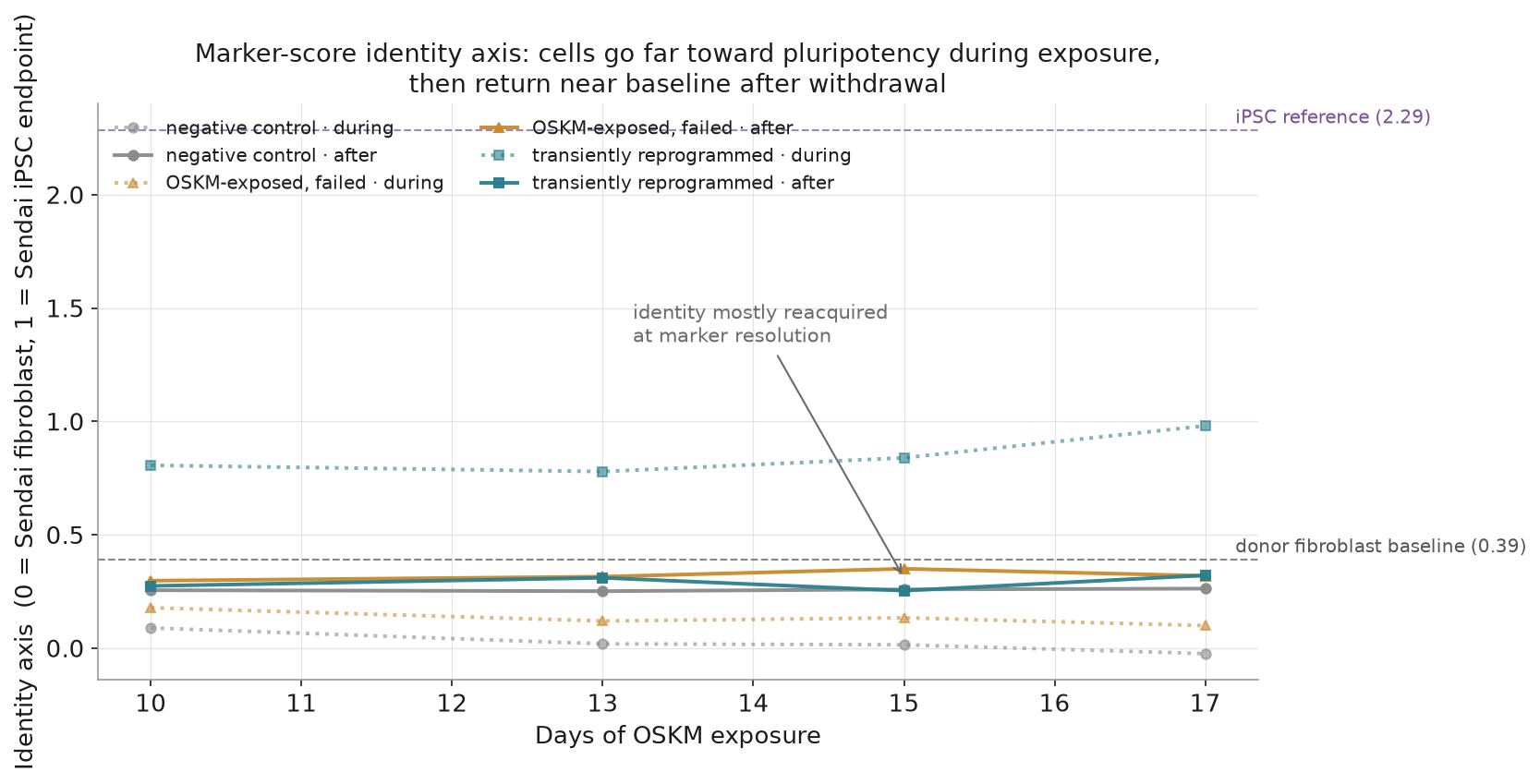
- During exposure: the reprogrammed arm's axis rises to a per-sample range of 0.76–1.08 (per-day medians 0.78–0.98) — cells do move toward pluripotency, about a quarter to half of the fibroblast→iPSC distance (the transient-experiment iPSC references read 2.29 on this axis, a purer state than the Sendai endpoint anchors). The failed arm reaches only 0.06–0.19; controls sit at −0.06 to 0.09.
- After withdrawal: group medians land in a narrow 0.26–0.39 band — reprogrammed 0.30, failed 0.32, control 0.26, donor baseline 0.39 (per-sample range 0.21–0.44) — with no between-arm difference in fibroblast marker score. At marker resolution, identity is largely reacquired — the paper's central claim holds at this layer.
- But not bit-perfect: the pluripotency score remains +0.29 SD above control after withdrawal — and the same elevation appears in the failed arm (+0.25 SD). Post-withdrawal cells keep a faint "touched by OSKM" transcriptional signature regardless of whether reprogramming succeeded. The paper itself observed a moderate transcription-age reduction in the failed arm and attributed it to reprogramming-factor expression alone — consistent with our reading of a non-specific exposure signature.
This cuts against both extremes: "identity completely intact" is wrong — a measurable residual signature exists; "cells became something else" is also wrong — on the marker axis they return to the control band. The honest statement: identity is largely reacquired with a non-specific OSKM-exposure signature retained; whether a residual subpopulation (e.g. a few still-intermediate cells lifting the group mean) hides inside the bulk measurement is indistinguishable here — which is exactly where explanation C (selection/subpopulation) cannot be fully excluded.
The clock–identity coupling: the core confound
Putting group-level medians on one plot — identity axis on x, Horvath1 on y — exposes the confound's shape: during-exposure reprogrammed cells cluster along the upper-right→lower-right diagonal (identity 0.76–1.08, age 12–40 y); post-withdrawal points return to the upper-left region (identity ~0.3, age 33–78 y), overlapping controls and failures. Spearman r = −0.33 (p = 0.007, n = 68 group-level cells). [Figure 4]
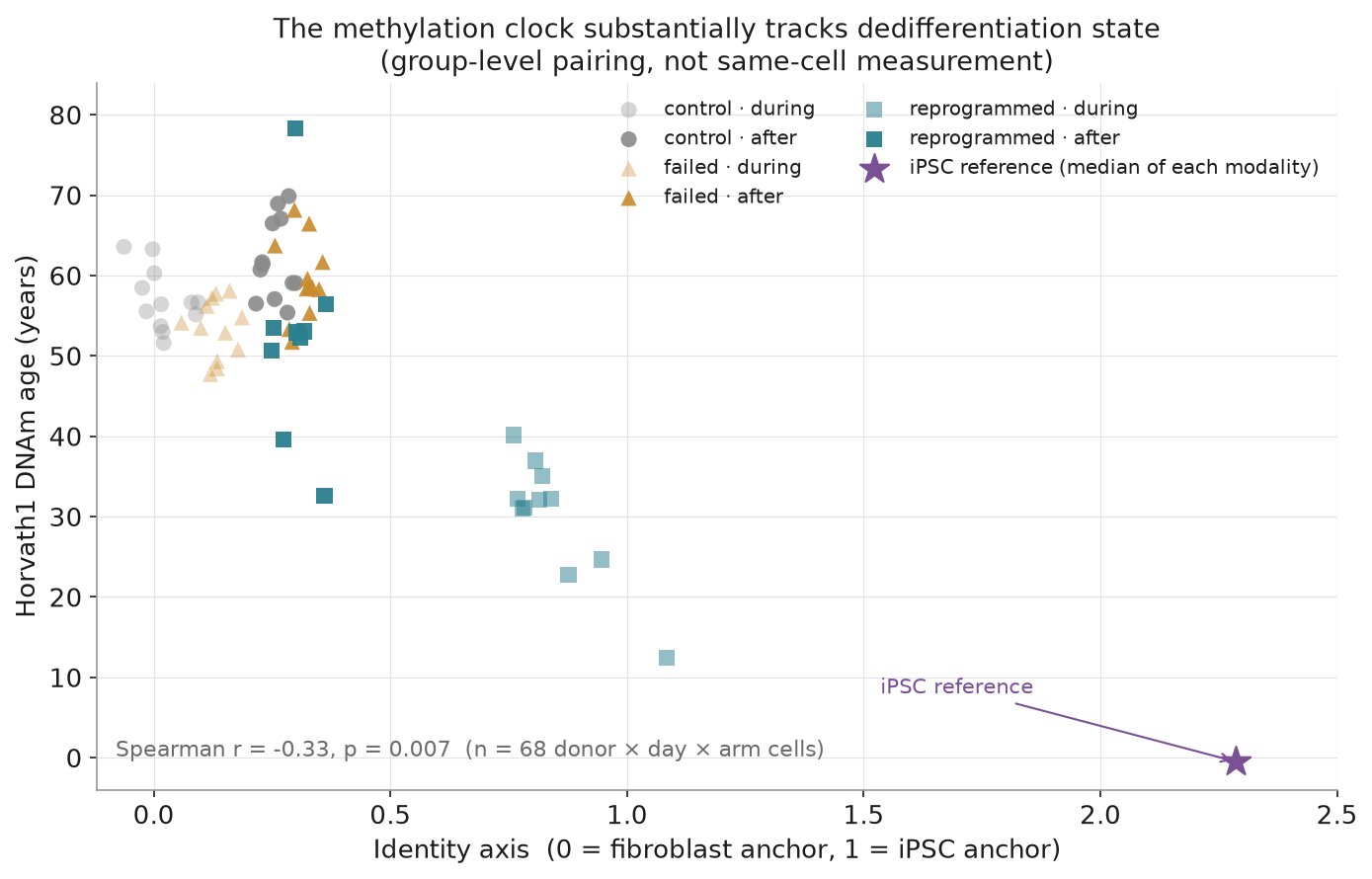
Two conclusions. First, clock readings are significantly coupled to dedifferentiation position: explanation D (measurement-algorithm response) is partly true — in this dataset the methylation clock is substantially a "reprogramming-progress meter", and much of the during-exposure "youth" is the coordinate system moving with the cell. Second, coupling is not everything: post-withdrawal cells return to the control identity band while retaining a clock offset (median −8.6 y) — that residual is the candidate evidence for persistent rejuvenation, but it is modest, variable per cell, and visible only on fibroblast-trained clocks.
The paper's own explanation for the weaker effect at 15/17 days is that "extended reprogramming may make reversion more difficult and cellular stresses 're-age' the methylome during the process" — consistent with our readings, but indistinguishable from a simpler account: the deep day-13 offset is partly driven by donor composition and a small cell (n = 4). Both explanations remain live.
Function layer: absent from the data, and the paper-level evidence discounts itself
The GEO matrices contain no functional assays — this layer cannot be verified from data. The paper-level functional evidence has three pieces, each weighed by the paper's own text:
- Migration (scratch wound): added at reviewer request. Middle-aged controls migrated more slowly than young controls; transient reprogramming "partially restored" migration speed — but the paper states that "the individual responses were quite variable and in some cases migration speed was improved and in other cases it was unaffected" and that it "did not appear to correlate with other aging measures such as transcription and methylation clocks". That is the paper's own report of readout–function dissociation: the deepest clock-reset cells are not necessarily the better-migrating cells.
- Collagen: collagen I/IV transcripts and immunofluorescence protein levels in reprogrammed cells moved toward "youthful levels" — directionally consistent, still a group-level measurement, and the paper itself notes the collagen I transcript restoration was not significant (small age difference, few samples).
- Morphology: roundness falls then recovers to the starting fibroblast state — consistent with the identity-axis account.
One in-paper negative result deserves keeping: the telomere-length clock shows MPTR does not extend telomeres and in some cases slightly shortens them — "rejuvenation" does not rewind all molecular attributes in step.
The honest functional statement: readouts changed and identity largely held, but "the cells function as younger" was never directly measured in this dataset; the paper-level functional evidence is small-n, variable, and decoupled from the clock readings.
Stability & safety layer: molecular state persists 4–5 weeks; tumour endpoints absent
What this dataset directly observes about stability: the final-phase samples are themselves measured after 4–5 weeks of post-withdrawal culture — so "the molecular state persists at least 4–5 weeks after withdrawal" is an observation, not an inference. Longer-term stability, karyotypic integrity, and tumorigenic potential are not measured at all.
The harm boundary comes from the in-vivo literature (abstract-level reading):
- Sustained expression → teratomas: Abad 2013 produced teratomas and iPS cells with totipotency features under continuous in-vivo OSKM expression — the direct consequence of "not stopping in time". Abad 2013
- Premature termination → cancer: Ohnishi 2014 reported that incomplete in-vivo reprogramming leads to cancer development through altered epigenetic regulation. Ohnishi 2014
- Hepatic/intestinal expression → premature death: Parras 2023 linked in-vivo reprogramming to premature death via hepatic and intestinal failure. Parras 2023
- Damage/senescence signals are double-edged: Mosteiro 2016 showed tissue damage and senescence provide critical signals for in-vivo reprogramming — aged/damaged tissue environments amplify reprogramming, complicating the dose-context relation. Mosteiro 2016
Genuine favourable evidence must be placed symmetrically: Lu 2020 expressed OSK (minus c-Myc) via AAV in retinal ganglion cells, restored vision, and reported no tumour increase under long induction; Ocampo 2016 extended lifespan in progeroid mice with cyclic OSKM; Chondronasiou 2022 rejuvenated naturally aged tissues multi-omically with a single transient cycle; Browder/Chondronasiou 2024 extended lifespan in aged mice with gene-therapy partial reprogramming. Lu 2020 Ocampo 2016 Chondronasiou 2022 Browder 2024 Factor sets, dose windows and tissue specificities differ enormously — in-vivo results cannot extrapolate to "a clock offset in a dish = safe", nor can in-vivo efficacy be taken as proof that the in-vitro mechanism is understood.
Verdict on the four competing explanations
| Explanation | Verdict | Key evidence |
|---|---|---|
| A. Local state restoration | Partly supported | The combination of post-withdrawal identity restoration and residual clock offset (median −8.6 y) is a real observation — but smaller than the headline, variable per cell, and clock-version sensitive |
| B. Dedifferentiation | Dominant during exposure | Clock and identity axis co-move during exposure (r = −0.33); the clock reads ~0 at iPSC — most during-exposure "youth" is explained by travelling the iPSC path |
| C. Selection / proliferative replacement | Not excluded; capped by the failed arm | The failed arm shows a −4.1 y median offset (Horvath1) and the same pluripotency residual — part of the effect is a non-specific OSKM-exposure/sorting signature; bulk data cannot resolve subpopulation structure |
| D. Measurement-algorithm response | Partly true | Only fibroblast-trained clocks move; readings couple to dedifferentiation position — but the post-withdrawal combination (identity back + offset retained) cannot be fully attributed to the algorithm |
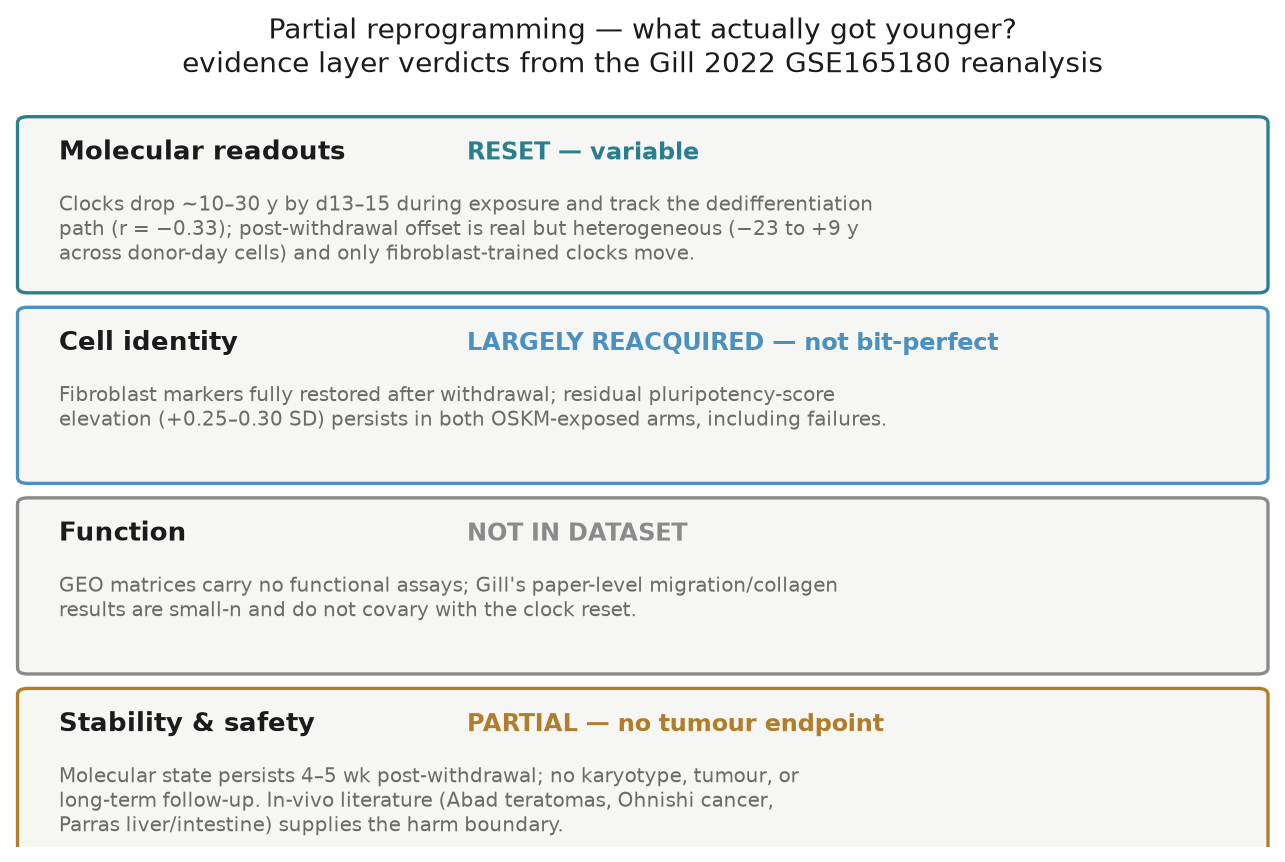
The four-layer verdicts, summarized in Figure 6:
What we know, and what we don't
Known:
- In the Gill dataset, methylation-clock reversal is real and still measurable 4–5 weeks after withdrawal — but the central tendency is a ~9-year median offset, not the "~30 years" in circulation; per-sample range −37 to +17 y (Horvath1), including cells that read older. That is still markedly deeper than earlier transient reprogramming — Sarkar 2020's initiation-phase transient transfection of the Yamanaka factors managed only ~3 years of methylome reversal Sarkar 2020.
- Clock movement is partly a dedifferentiation gauge — it falls with the identity axis during exposure; the discriminating residual only counts after withdrawal.
- Fibroblast identity is largely reacquired at marker resolution; the residual pluripotency signature is a shared OSKM-exposure scar, present even in the failed arm.
- The "optimal 13–15-day window" is entangled with donor composition and small cells and cannot be separated from noise.
- Functional improvement was never directly measured; the paper-level migration evidence is variable and decoupled from clock readings; telomeres do not rewind.
- The in-vivo literature gives a concrete harm list — teratomas, cancer after premature termination, hepatic/intestinal failure — alongside genuine benefit reports stratified by factors, dose and tissue.
Unknown:
- The per-cell joint clock–identity trajectory (cross-modal measurements are not same-cell);
- Whether the residual pluripotency signature carries functional consequences or marks a risk subpopulation;
- Long-term (>4–5 week) molecular state, karyotype, tumorigenicity;
- Any extrapolation from these in-vitro readings to human function or healthspan;
- Whether other transient-reprogramming protocols decompose the same way (this analysis covers MPTR only).
Methods and update notes
- Data: GSE165180 (GEO, downloaded 2026-09-18), 96 methylation + 95 RNA samples; processed matrices (NOOB betas / Log2 RPM), not raw idat/FASTQ.
- Implementation: five clocks per biolearn coefficients (Horvath1 334/353 CpGs, row-mean imputed; others 65–514 of 71–514); identity axis is an analyst-defined 25-marker z-score axis anchored on the Sendai trajectory.
- Statistics: all contrasts are group-median differences with nominal Mann–Whitney p; the independent unit is 3 donors and per-cell n is 2–6 — p-values are exploratory flags only; cross-modal analysis joins group medians, not cells.
- Code and outputs:
research/calculations/partial-reprogramming-identity/(analysis plan, reanalysis script, per-sample outputs, joint table, log) andresearch/assets/partial-reprogramming-identity/(figures and reproducibility bundle). - Self-review: performed by the same agent that authored the article; score and revision record are in the
reviewsfield of the research record; not an independent review. - Competing interests note: Gill 2022 senior author Wolf Reik's listed affiliation is the Altos Labs Cambridge Institute — partial reprogramming is Altos's core program; the study is in-vitro methodology and does not constitute product evidence.
Sources
- <a id="source-s1"></a>s1: Gill D, Parry A, Santos F, et al. Multi-omic rejuvenation of human cells by maturation phase transient reprogramming. eLife 2022;11:e71624 (PMC9023058, full text including reviewer exchange)
- <a id="source-s2"></a>s2: GEO SuperSeries GSE165180 (subseries GSE165176–179), "Multi-omic rejuvenation of human cells by maturation phase transient reprogramming", downloaded 2026-09-18
- <a id="source-s3"></a>s3: biolearn clock coefficients (Horvath1/Horvath2/Hannum/PhenoAge/EpiTOC) + Horvath 2013 Genome Biology 14:R115 method paper
- <a id="source-s4"></a>s4: Sarkar TJ et al. Transient non-integrative expression of nuclear reprogramming factors promotes multifaceted amelioration of aging in human cells. Nat Commun 2020 (PMC7093390, full text)
- <a id="source-s5"></a>s5: Abad M et al. Reprogramming in vivo produces teratomas and iPS cells with totipotency features. Nature 2013 (abstract-level)
- <a id="source-s6"></a>s6: Ohnishi K et al. Premature termination of reprogramming in vivo leads to cancer development through altered epigenetic regulation. Cell 2014 (abstract-level)
- <a id="source-s7"></a>s7: Parras A et al. In vivo reprogramming leads to premature death linked to hepatic and intestinal failure. EMBO Mol Med 2023 (abstract-level)
- <a id="source-s8"></a>s8: Mosteiro L et al. Tissue damage and senescence provide critical signals for cellular reprogramming in vivo. Science 2016 (abstract-level)
- <a id="source-s9"></a>s9: Lu Y et al. Reprogramming to recover youthful epigenetic information and restore vision. Nature 2020 (PMC7752134, full text)
- <a id="source-s10"></a>s10: Ocampo A et al. In vivo amelioration of age-associated hallmarks by partial reprogramming. Cell 2016 (PMC5679279, full text)
- <a id="source-s11"></a>s11: Chondronasiou D et al. Multi-omic rejuvenation of naturally aged tissues by a single cycle of transient reprogramming. Aging Cell 2022 (PMC8920440, full text)
- <a id="source-s12"></a>s12: Browder KC / Chondronasiou D et al. Gene therapy-mediated partial reprogramming extends lifespan and reverses age-related changes in aged mice. Cell Reprogram 2024 (PMC10909732, full text)
- <a id="source-s13"></a>s13: Legacy site article 122 "Cellular reprogramming: Yamanaka factors for organ rejuvenation" — the article this study revises (snapshot archived)
Scope & limitations
- The independent biological unit is 3 donors; each condition-by-day cell holds n=2-6, and donor composition is unbalanced across days (the day-13 reprogrammed group is only O2+O3, day-15 only O3) — the 'optimal window' cannot be separated from donor noise (c6).
- Cross-modal (methylation<->RNA) alignment is group-level only, not per-cell pairing; an individual-level clock-identity trajectory cannot be established (c3).
- Inputs are the author's processed beta values and Log2 RPM, not raw idat/FASTQ; our clock implementation differs from the paper's (no Horvath gold-standard normalisation, row-mean imputation of 19 missing Horvath1 CpGs) (c1, c2).
- The marker scores and identity axis are analyst-defined exploratory metrics, not validated identity assays; bulk averaging cannot resolve residual subpopulations (c4, c5).
- The function layer has no data: GEO contains no functional assay, and the paper-level functional evidence (migration/collagen) is small-sample and, per the paper itself, uncorrelated with clock readings (c8).
- No tumour, karyotype, or beyond-4-5-week endpoints exist; the in-vivo hazard/benefit evidence mixes abstract-level with full-text reading and is not a systematic review (c9, c10).
Sources
- Gill D et al. Multi-omic rejuvenation of human cells by MPTR. eLife 2022;11:e71624
paper · Source version: PMC full text including peer-review file and author responses, downloaded 2026-09-18
Reading scope
Full text
Full text read including reviewer exchange. Key facts verified: MPTR design (10/13/15/17d exposure + 4-5wk post-withdrawal); 3 middle-aged donors; negative-control and failed-arm sorting definitions; migration 'quite variable... did not correlate with clocks'; telomere not extended; bespoke transcriptome clock built after existing clocks failed on controls; Reik affiliated with Altos Cambridge Institute
- Abstract: transcriptome ~30 y, methylation clocks a similar extent, identity lost then reacquired
- Figure 1: full Sendai-trajectory methylation age ~20 y reversal by day 10, ~40 y by day 17
- Figure 3: PC1 projection ~40 y, bespoke BiT clock ~30 y; migration results reported as variable and uncorrelated with clocks
- Figure 4: methylation-clock results; telomere-length clock unaffected
- Methods: CD13-/SSEA4+ vs CD13+/SSEA4- sorting, 4-5-week withdrawal, donor epigenetic ages 45/49/55
- GEO SuperSeries GSE165180 (subseries GSE165176–179)
dataset · Source version: SOFT metadata + processed matrices (Log2 RPM / NOOB beta), downloaded 2026-09-18, SHA256 archived
Reading scope
Full text
Matrices and SOFT metadata audited: 3 donors (O1/O2=53y, O3=38y); group-level cross-modal linkage only, not per-cell; donor composition unbalanced across days (d13 reprogrammed = O2+O3 n=4, d15 = O3 n=2); one truncated 555MB methylation download re-fetched and gzip-validated
- GSE165177/179: MPTR transient experiment, 95 RNA + 96 methylation samples
- GSE165176/178: full Sendai trajectory (incl. the d54_SSEA4 iPSC endpoint)
- Sample naming parsed into donor x condition x days x phase; O1/O2=53, O3=38 chronological
- biolearn clock coefficients (5 models) + Horvath 2013 method paper
method · Source version: biolearn model coefficient CSV raw files, downloaded 2026-09-18
Reading scope
Full text
Coefficient files verified one by one; implementation differences from the paper (no gold-standard normalization, row-mean imputation of 19 missing Horvath1 CpGs) declared in text and limitations
- Horvath1: 353 CpG + anti_trafo(sum+0.696)
- Horvath2 skin+blood: 391 CpG + anti_trafo transform
- Hannum/PhenoAge/EpiTOC: linear sums over 71/513/385 CpGs
- Sarkar TJ et al. Transient non-integrative OSKM expression ameliorates aging in human cells. Nat Commun 2020
paper · Source version: PMC full text, downloaded 2026-09-18
Reading scope
Full text
Full text read; comparator transient protocol (mRNA delivery) — Gill claims larger magnitude but concedes direct comparison needed
- mRNA transient-expression initiation-phase protocol: multi-marker improvement in human fibroblasts/endothelial cells
- Comparative context for the MPTR protocol (~3 y methylome reversal)
- Abad M et al. In-vivo reprogramming produces teratomas and iPS cells with totipotency. Nature 2013
paper · Source version: PubMed abstract (efetch), 2026-09-18
Reading scope
Abstract
Abstract-level; direct harm anchor for sustained in-vivo expression
- Sustained in-vivo OSKM expression produces teratomas and iPS cells with totipotency features
- Ohnishi K et al. Premature termination of in-vivo reprogramming leads to cancer. Cell 2014
paper · Source version: PubMed abstract (efetch), 2026-09-18
Reading scope
Abstract
Abstract-level; harm anchor for premature/incomplete termination
- Premature termination of in-vivo reprogramming leads to cancer through altered epigenetic regulation
- Parras A et al. In-vivo reprogramming → premature death via hepatic/intestinal failure. EMBO Mol Med 2023
paper · Source version: PubMed abstract (efetch), 2026-09-18
Reading scope
Abstract
Abstract-level; tissue-specific toxicity anchor
- In-vivo reprogramming leads to premature death linked to hepatic and intestinal failure
- Mosteiro L et al. Tissue damage and senescence signal in-vivo reprogramming. Science 2016
paper · Source version: PubMed abstract (efetch), 2026-09-18
Reading scope
Abstract
Abstract-level; mechanistic anchor for dose-context complexity
- Tissue damage and senescence provide critical signals for in-vivo reprogramming
- Lu Y et al. Reprogramming to recover youthful epigenetic information and restore vision. Nature 2020
paper · Source version: PMC full text (NIHMS), downloaded 2026-09-18
Reading scope
Full text
Full text read; favourable in-vivo counterweight — OSK minus c-Myc, tissue-targeted, functional endpoint (vision), TET1/2-dependent
- OSK (minus c-Myc) AAV -> RGC axon regeneration/vision restoration; long-term induction reported no tumour increase
- TET1/2 dependence
- Ocampo A et al. In-vivo amelioration of age-associated hallmarks by partial reprogramming. Cell 2016
paper · Source version: PMC full text (NIHMS), downloaded 2026-09-18
Reading scope
Full text
Full text read; foundational in-vivo benefit evidence, bounded to a progeroid model
- Cyclic OSKM induction extends progeroid mouse lifespan; improved metabolic/muscle-injury recovery in wild type
- Chondronasiou D et al. Single-cycle transient reprogramming rejuvenates naturally aged tissues. Aging Cell 2022
paper · Source version: PMC full text, downloaded 2026-09-18
Reading scope
Full text
Full text read; in-vivo evidence in natural (non-progeroid) aging
- A single cycle of transient reprogramming multi-omically rejuvenates naturally aged tissues
- Gene therapy-mediated partial reprogramming extends lifespan in aged mice. Cell Reprogram 2024
paper · Source version: PMC full text, downloaded 2026-09-18
Reading scope
Full text
Full text read; latest gene-therapy direction, design caveats noted
- AAV gene-therapy partial reprogramming extends aged-mouse lifespan
- Legacy article 122: Cellular reprogramming — Yamanaka factors for organ rejuvenation
legacy · Source version: WP API + front-end snapshot archived 2026-09-18
Reading scope
Full text
Identity verified three ways (API read-back, legacy-index, local snapshot); increment of this study is the four-layer GSE165180 reanalysis
- Old draft is a relatively balanced review already covering Yamanaka factors, teratoma risk and the 'partial reprogramming' direction
Authorship & review
Author self-review · Devin (AI agent)
2026-09-18 · The author's own focused review of the whole article, performed by the same agent: agreement between the main question (what actually became younger in partial reprogramming - readings, identity, or function) and scope; actual reading depth of load-bearing sources (Gill 2022 full text incl. peer-review file, all four GSE165180 subseries matrices and metadata, biolearn coefficients + Horvath 2013 method, full texts of Sarkar/Lu/Ocampo/Chondronasiou/Browder; abstract-level for Abad/Ohnishi/Parras/Mosteiro); whether the analysis plan was locked before use; the clock implementation being honestly disclosed (biolearn coefficients, no gold-standard normalisation, row-mean imputation of 19 CpGs); cell-by-cell checking of every load-bearing number against the computation CSVs; adjudication of four competing explanations (local state restoration / dedifferentiation / selection / algorithm response) using the failed arm and negative controls; statistical calibration (group-level not per-cell, 3 donors, nominal p, donor imbalance); retention of unfavourable and boundary evidence (clock variability, cells that read older, non-zero failed-arm residual, the optimal window entangled with donors, absent functional data, hazard list); translation consistency and overstated claims; safety boundary (no protocol or dosing). Method: mechanical checks first (zero CJK in the English file, identical source anchors), then every load-bearing number was checked against the output files, then paper quotations were re-verified, then a 0-10 self-score; one revision round preceded the final rating. Rebound on 2026-09-18 to the version that adds the English localization of the record metadata (limitations, conflicts, source reading notes, review scopes): that change only adds localized fields, the record with the localized fields removed is byte-for-byte identical to the previous version (verified by git comparison), and it introduces no new research conclusion, number, source or qualification, so this score and the findings listed with it continue to apply to the current record. The English text of the localization was written and checked against the Chinese line by line by this agent.
Remaining limitations:
- This self-review was performed by the same agent that authored the article; it is not an independent, human, or professional review. The clock implementation follows biolearn coefficients (no gold-standard normalisation) - direction-consistent with the paper but absolute ages may be offset.
- Inputs are the author's processed matrices (NOOB beta / Log2 RPM), not raw idat/FASTQ - normalisation-level recomputation is impossible; readings can only be checked under the same matrices.
- Bulk RNA averaging cannot resolve a residual subpopulation (explanation C, selection/replacement, is only bounded by the failed arm, not excluded); cross-modal data join only at group-level medians, so an individual clock-identity trajectory cannot be proven.
- The in-vivo hazard/benefit evidence mixes abstract-level with full-text reading and is not a systematic review; the function layer has no data in these GEO matrices and the paper-level functional evidence is itself variable and decoupled from clocks.
Editorial approval · Devin (AI agent)
2026-09-18 · Editorial sign-off executed by the same agent that authored the article, explicitly in a different working role — not independent, human, or professional review. Checked against the publication-blocking list: (1) source identity and versions — Gill 2022 full text + review history, the four GSE165180 subseries processed matrices, biolearn coefficients, and every load-bearing PMCID verified and archived with SHA256 (several initial PMCID mismatches were corrected); (2) no conclusion reversed relative to sources — clock variability, cells that read older, the failed arm's non-zero residual, the optimal window's donor-composition confound, absent functional data, and no telomere rewind are all retained; (3) denominators and statistical objects — 3 donors, n=2-6 per cell, group-level not per-cell, nominal p-values, donor imbalance all stated; (4) no model assumption used to prove reality — the identity axis is an analyst-defined exploratory metric, cross-modal alignment is group-level, and clock-implementation differences are disclosed; (5) safety gap — no reprogramming protocol or dosing is given, and in-vivo hazard and benefit evidence is presented symmetrically; (6) public scope is evidence_description and does not trigger professional review. Covers the current English text. Rebound on 2026-09-18 to the version that adds the English localization of the record metadata (limitations, conflicts, source reading notes, review scopes): that change only adds localized fields, the record with the localized fields removed is byte-for-byte identical to the previous version (verified by git comparison), and it introduces no new research conclusion, number, source or qualification, so this score and the findings listed with it continue to apply to the current record. The English text of the localization was written and checked against the Chinese line by line by this agent.
Translation check · Devin (AI agent)
· The same agent wrote the English text from the same evidence record rather than translating sentence by sentence, then compared it section by section against the Chinese. Checked: identical statistics (per-day offsets -6.4/-22.9/-9.8/-0.1 y; pooled medians -8.6/-4.1/0; per-sample H1 range -36.6/+16.8; donor x day H1 -30.3/+9.3 and H2 -33.7/+19.0; exposure trajectory H1 37->16, H2 27->11; identity axis 0.76-1.08 during exposure, 0.26-0.39 group medians / 0.21-0.44 per-sample after withdrawal, failed 0.32, iPSC 2.29; pluripotency residual +0.29/+0.25 SD; Spearman r=-0.33 p=0.007 n=68; clock coverage 334/353); every qualification preserved (group-level-only pairing, three donors, nominal p, donor imbalance confounding the optimal window, failed-arm non-zero residual, no functional data, hazard list); source anchors s1-s13 identical between languages; zero CJK characters in the English file. Rebound on 2026-09-18 to the version that adds the English localization of the record metadata (limitations, conflicts, source reading notes, review scopes): that change only adds localized fields, the record with the localized fields removed is byte-for-byte identical to the previous version (verified by git comparison), and it introduces no new research conclusion, number, source or qualification, so this score and the findings listed with it continue to apply to the current record. The English text of the localization was written and checked against the Chinese line by line by this agent.
Funding & interests
None. This article is a recomputation of public data plus an evidence-layering exercise.
Funding of cited research
Gill 2022 senior author Wolf Reik's listed affiliation includes the Altos Labs Cambridge Institute (partial reprogramming is Altos's core programme); that study is in-vitro methods work. A Sarkar 2020 author has a Turn Biotechnologies affiliation. Disclosed as relevant context; it does not change the data.