The answer we reached
Most of this "paradox" is a category error: the word "mTOR" covers at least three different things in the evidence — pulsatile activation after feeding/training, chronically elevated baseline activation inside aged fibres, and chronic systemic pharmacological suppression. Pulsatile activation drives muscle protein synthesis and adaptation (human evidence: rapamycin abolishes the contraction-induced MPS rise); focally sustained mTORC1 activation in aged fibres co-localises with fibre damage and loss (Tang 2019, mouse and human tissue); and the lifespan evidence comes from systemic, regimen-dependent suppression (the ITP rapamycin trial, transient rapamycin, low-protein/low-isoleucine diets). But the paradox is not all semantics — a real residual trade-off remains: chronic systemic mTORC1 suppression measurably blunts muscle adaptation. In RAPA-EX-01, weekly sirolimus 6 mg attenuated 13-week functional gains (ITT −2.13 chair-stand repetitions, reaching significance in sensitivity analyses); Tang's rapamycin preserved fibre number in aged muscle but not fibre size or wet weight. The conclusion: eat the protein (the older threshold is shifted, not reversed), do the training (its contribution dwarfs supplementation), and "mTOR inhibition extends lifespan" currently holds only at the animal layer — the human layer offers immune-function signals and one signal of functional blunting. Converting animal lifespan readouts into "eat less protein / take rapamycin to stay young" is a layer violation.
| What we did | What we found | What we did not answer |
|---|---|---|
| Rebuilt young-vs-old MPS dose-response (Moore, Yang, Wall, Symons) | Plateau dose shifts ~1.7x by body mass (0.24→0.40 g/kg), ~2.4x by lean mass (0.25→0.60 g/kg); direction unchanged | Plateau estimates have overlapping CIs; FSR protocols (mixed vs myofibrillar) not fully comparable |
| Pooled protein RCTs under matched training (Tieland, Verreijen, PROVIDE, Cermak, Morton) | Between-arm lean/appendicular gains ~0.2–1.3 kg over 3–6 months; 1RM ~+2.5–13.5 kg; effect shrinks with age; breakpoint ~1.62 g/kg/d | Few older-adult RCTs (13 of Morton's studies >45 y); no individual data |
| Function-translation audit | Mass gains convert to function only inconsistently: PROVIDE chair-stand significant, grip/SPPB null; Verreijen function null; protein ~9% of 1RM gain | Function endpoints are insensitive at short durations; most RCTs were powered for mass |
| Lifespan layer, direction × conditions | Animals consistently favour suppression, but strongly conditional: sex (Bitto male-only, Green M +33% vs F +7%), strain (B6 vs HET3), regimen | No human lifespan data; mouse strain/microbiome/cancer-driven mortality limit extrapolation |
| Direct human test (RAPA-EX-01) | Weekly sirolimus 6 mg + 13-wk exercise: ITT −2.13 reps (p=0.089), CC/PP significant; AE burden 99 vs 63 | 40-person exploratory trial, 13 weeks, single timing scheme; significance concentrated in sensitivity analyses |
| Mechanistic adjudication | Five competing explanations scored one by one (table below) | The upstream cause of mTORC1 activation in aged fibres remains unknown (denervation hypothesis) |
Scope: a layered assessment of protein×resistance-training and mTOR-inhibition evidence in adults, emphasising older adults. Not a full rapamycin review (covered elsewhere in this library); not all protein epidemiology; acute signal, chronic adaptation, function and lifespan conclusions are not interchangeable. No human lifespan or healthspan data exist — this article makes no such claim, and prescribes no intake or medication.
Four different "mTORs" hide inside the paradox
"mTOR inhibition fights aging" and "mTOR maintains muscle" are both true — but their mTORs are not the same thing:
- Pulsatile activation: within hours of a protein meal or a resistance bout, fibre-intrinsic mTORC1 transients drive the MPS pulse — the engine of adaptation. Rapamycin completely blocks contraction-induced S6K1 phosphorylation and the early MPS rise in humans (Drummond 2009)[s6]; mTORC1 is required for EAA-stimulated MPS in human muscle (Dickinson 2011)[s7].
- Chronic baseline activation: aged mouse muscle shows ~11%±2% pS6-positive fibres (rare in young), human latissimus dorsi shows 3%±1% in a younger cohort (42±12 y) and markedly more at 78 y, co-localising with morphological damage and activated caspase-3 (Tang 2019)[s22]; muscle-specific TSC1 knockout (MCK-cre) constitutive activation produces ~50% fibre loss in the gastrocnemius lateral head by 18 months, and the model itself is short-lived (~39% surviving to 18 months).
- Systemic pharmacological suppression: the ITP lifespan extension (Harrison 2009)[s13] is low-dose, chronic, whole-body — it suppresses the baseline, not only the pulses.
- Amino-acid sensing input: Solon-Biet 2014's 25-diet geometric framework shows liver mTOR activation is driven chiefly by the circulating BCAA:glucose ratio (3-fold range), not total calories[s15] — the lifespan readout is modulated by dietary amino-acid profile, not a simple protein on/off switch.
One word covering four time and spatial scales — the paradox is pre-loaded at the level of definition.
Acute layer: older muscle needs a higher threshold, not "more protein"
Across four human dose studies, the age effect is a clean threshold shift, not a direction change:
- Moore 2009 (young men, 0–40 g whole-egg protein post-exercise): MPS maximal at 20 g, no further gain at 40 g[s1].
- Yang 2012 (~71-y men, whey 0/10/20/40 g + resistance): whey 20 g/40 g raised MPS by +65%/+90%; per the authors, rested muscle saturates at 20 g while exercised muscle responds further to 40 g[s2] — anabolic resistance is mainly a resting-state phenomenon; trained older muscle retains headroom.
- Wall 2015 (biphasic myofibrillar fit): plateau 0.40 vs 0.24 g/kg body mass (older vs young, p=0.055); 0.60 vs 0.25 g/kg lean mass (p<0.01); basal MPS identical (0.027 vs 0.028 %/h)[s3].
- Symons 2009 (lean-beef meals): 30 g protein raises mixed-muscle FSR ~50%, 90 g adds nothing — same in both age groups at rest[s4]; at matched doses, whey stimulates postprandial accretion more than casein in older men (Pennings 2011)[s5].
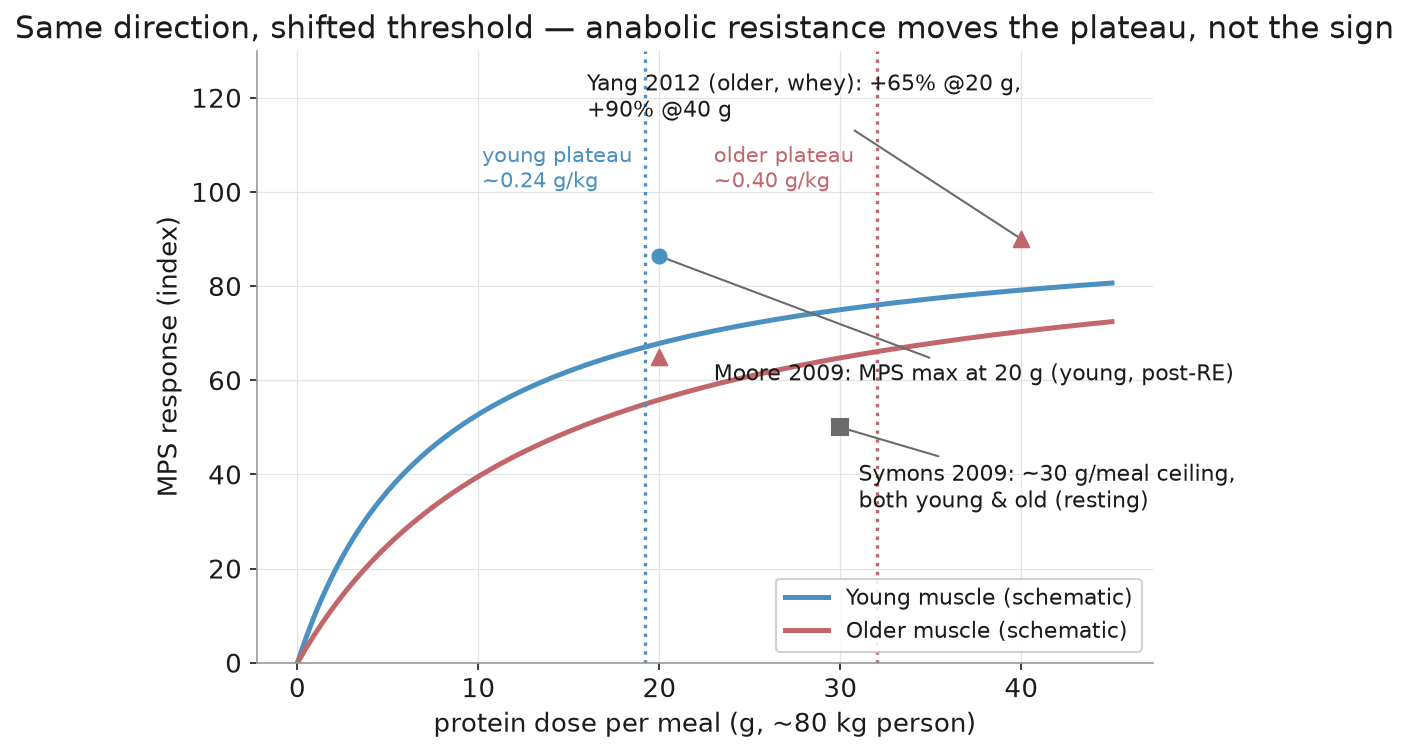
Read: anabolic resistance is not "old muscle can't synthesise" — basal rate unchanged, direction unchanged, training still amplifies; what changed is the per-meal dose needed to trigger the same pulse (~1.7x). PROT-AGE therefore recommends >65 y: 1.0–1.2 g/kg/d, ≥1.2 for the active, 1.2–1.5 for chronic disease[s11] — meeting the "low protein for longevity" mouse readout head-on. This is the paradox's first battlefield.
Chronic layer: protein adds a small, real mass gain on the same training
Every chronic comparison is locked to the same training background, isolating protein's own contribution:
- Tieland 2012: 62 frail elderly (78 y), 24-wk resistance, 2×15 g/d protein vs placebo: lean mass +1.3 kg (47.2→48.5) vs unchanged (45.7)[s8].
- Verreijen 2015: 127 obese older adults, weight loss + exercise 13 wk, 1.11 vs 0.90 g/kg/d: appendicular mass +0.4 vs −0.5 kg, β=0.95 kg (95%CI 0.09–1.81, p=0.03)[s9].
- PROVIDE 2015: 380 sarcopenic adults, leucine/vitamin-D-enriched whey + light exercise 13 wk: appendicular mass +0.17 kg (0.004–0.338, p=0.045)[s10].
- Cermak 2012 meta (22 RCTs): lean mass +0.69 kg (0.47–0.91), 1RM leg press +13.5 kg (6.4–20.7)[s12].
- Morton 2018 meta (49 RCTs, 1863 participants): FFM +0.30 kg (0.09–0.52), 1RM +2.49 kg (0.64–4.33); breakpoint ~1.62 g/kg/d; effect declines with age (−0.01 kg/year, p=0.002)[s14].
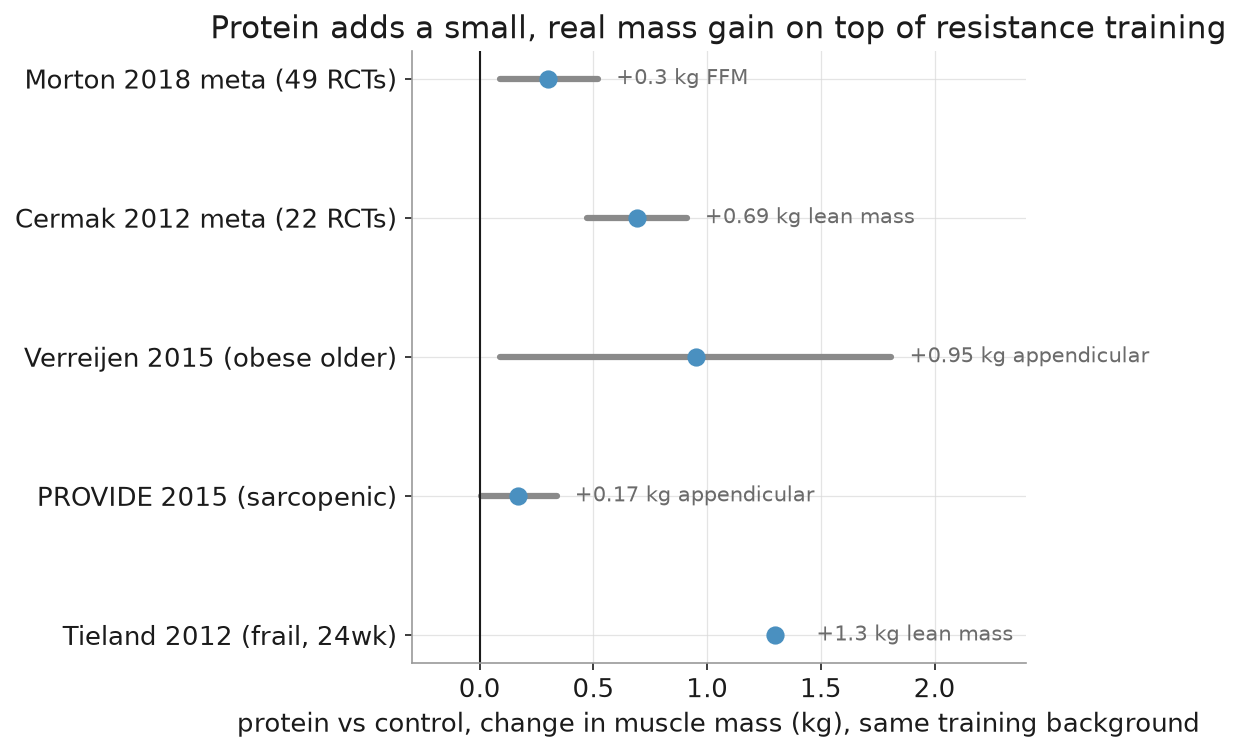
Mind the magnitude: in Morton, RET itself drives far more FFM gain than protein's +0.30 kg — resistance training is the stimulus; protein is the amplifier, not the engine. Effects shrink further in older subgroups (13 trials >45 y, baseline intake already ~1.4 g/kg/d), so carrying the pooled mean into an individual prescription requires discounting.
Function layer: mass-to-function translation is not automatic
Muscle mass is a surrogate; function is what readers care about. Trial by trial:
- PROVIDE: chair-stand improved more with the supplement (significant), but grip and SPPB improved equally in both arms[s10].
- Verreijen: strength/function improved over time, no between-group difference[s9].
- Morton: protein accounts for ~9% of the 1RM gain; ~91% comes from training itself[s14].
- RAPA-EX-01 (2026): 40 sedentary adults 65–85 y, weekly sirolimus 6 mg vs placebo + 13-wk home resistance/endurance programme, dosing placed 24 h after the last weekly session. Primary ITT: −2.13 30-s chair-stand repetitions (95%CI −4.61 to 0.34, p=0.089); sensitivity analyses reached significance: complete-case −2.46 (p=0.045), per-protocol −3.44 (p=0.007); grip/6MWD/SF-36 all favoured placebo, non-significant[s21].
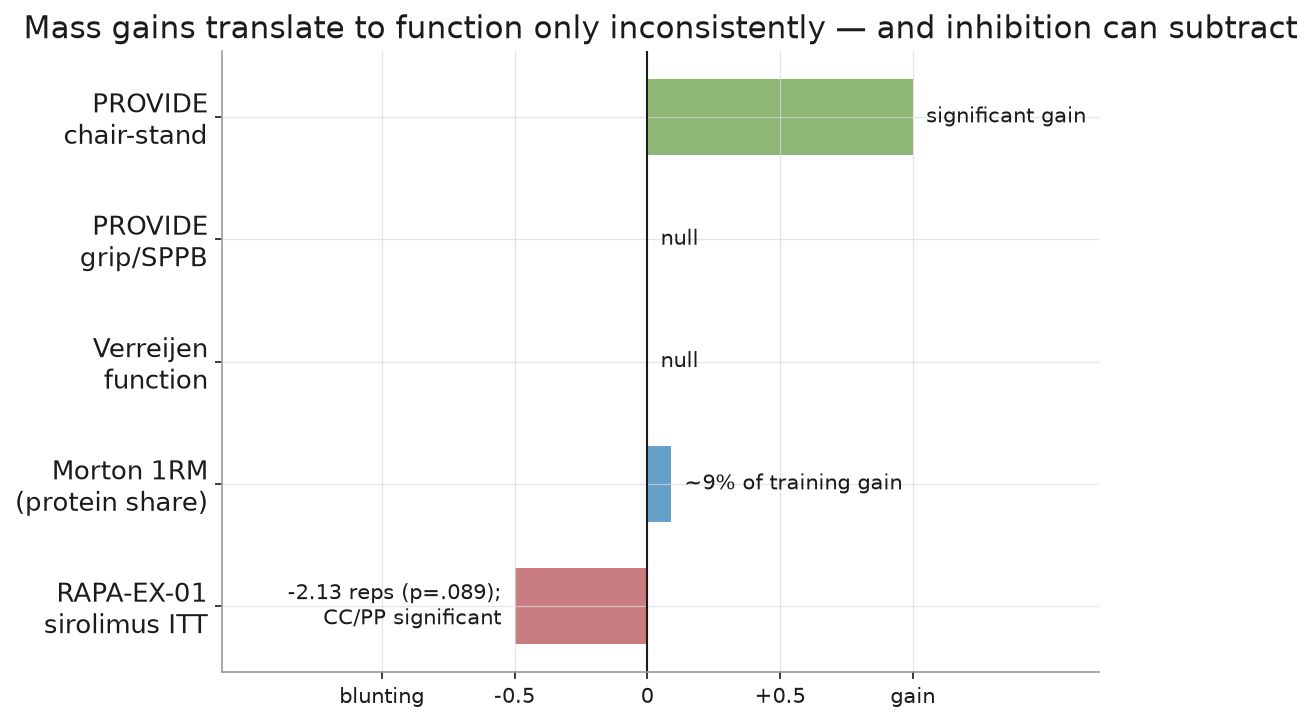
Two readings: first, mass gains cash out to function only inconsistently — most function endpoints sit inside noise at 13-week scales; second, mTORC1 inhibition's "subtraction" showed a human function-layer signal — honestly flagged: significance lives in sensitivity analyses (the 5:3 dropout imbalance inflates per-protocol effects), and a 40-person exploratory trial cannot carry a definitive conclusion.
Lifespan layer: the suppression direction is real, and entirely conditional
Animal evidence for "mTOR suppression extends lifespan" is consistent and multi-line — and strongly condition-dependent:
- Harrison 2009 (ITP, UM-HET3, 14 ppm from 600 d): mean lifespan +9% males, +13% females (site range M 5–15%, F 7–16%)[s13].
- Bitto 2016 (B6, 3-month transient from 20 months): injected males gained +60% post-treatment life expectancy and +16% overall median lifespan; females: no effect; fed arm sex-pooled median +13%[s16].
- Solon-Biet 2014 (B6, 858 mice, 25 diets): median lifespan rose ~95→125 weeks (~30%) as protein:carbohydrate ratio fell, independent of total calories (its 2015 follow-up further separated P:C ratio from caloric restriction[s25]); the same low-P:C diets raised body fat, reduced lean mass and produced fatty liver — the lifespan-maximising formula itself damaged body composition[s15].
- Green 2023 (UM-HET3, isoleucine −67%): male median +33% (max lifespan significant), female only +7% with no max effect; all-amino-acid −67% produced no lifespan effect in HET3[s17].
- Cummings 2018: BCAA −67% restored glucose tolerance and reduced fat in obese B6 — metabolic endpoints, not lifespan[s18].
- Mannick 2014/2018 (humans): RAD001 improved influenza-vaccine response ~20%; RTB101 reduced infection rates in the elderly (p=0.001) — the human layer stops at immune function; there are no lifespan readouts[s19][s20].
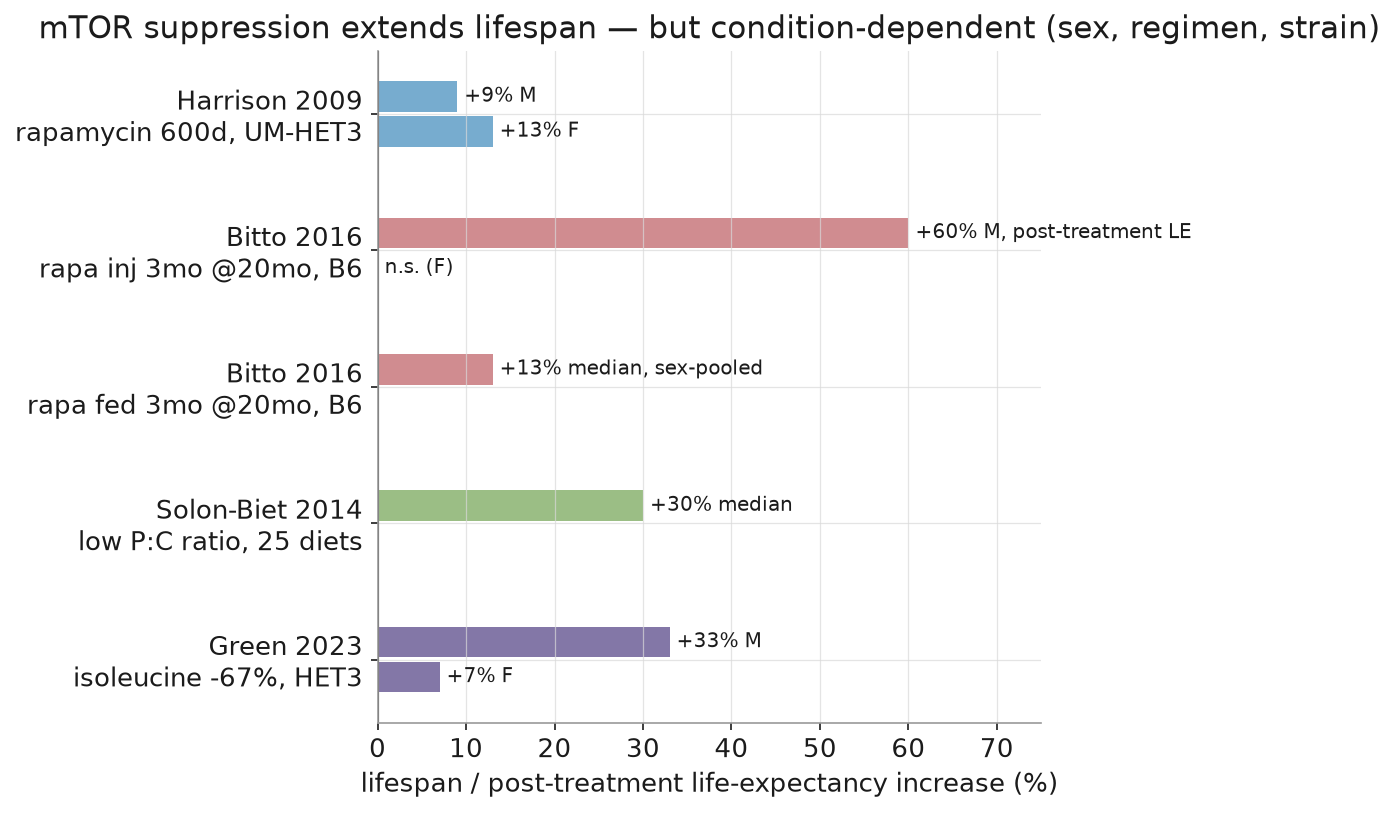
Condition-dependence is part of the conclusion, not a footnote: Bitto's +60% exists only in males, injected, as post-treatment life expectancy; in Green, all-amino-acid restriction failed in the same strain where single-amino-acid restriction worked — "low protein extends lifespan" does not even hold across HET3 protocols; the active ingredient is the specific amino-acid profile. And Solon-Biet's longevity-winning formula carried its own lean-mass cost — the paradox lives inside a single experiment.
Adjudication: scoring the five competing explanations
| Explanation | Verdict | Basis |
|---|---|---|
| A Real trade-off: mTOR keeps muscle yet accelerates aging | Partially supported | Muscle genuinely needs mTORC1 (Bentzinger raptor KO → progressive dystrophy[s23]; Drummond/Goodman blockade blunts synthesis[s6][s24]; RAPA-EX blunted function[s21]); chronic systemic suppression measurably antagonises muscle adaptation |
| B Pulsatile vs chronic: mixed time scales | Strongly supported | Pulsatile activation drives adaptation; sustained baseline activation co-localises with damage in aged fibres (Tang)[s22]; rapamycin suppresses baseline but preserves fibre number not size — both halves of the paradox inside one experiment |
| C Tissue specificity: muscle vs systemic | Partially supported | Lifespan benefit is systemic (Solon-Biet liver mTOR responds to BCAA:glucose; Mannick immune); muscle-cell-autonomous requirement proven (Goodman)[s24]; indiscriminate tissue suppression is the source of the residual trade-off |
| D Dose nonlinearity: different curves per outcome | Supported | Protein→MPS saturates ~20–40 g/meal and ~1.62 g/kg/d; protein→lifespan favours low P:C in mice — "optimal" is outcome-specific |
| E Anabolic resistance: threshold shift, not direction | Supported | Wall 0.40 vs 0.24 g/kg; basal MPS unchanged; Yang exercised muscle still responds to 40 g |
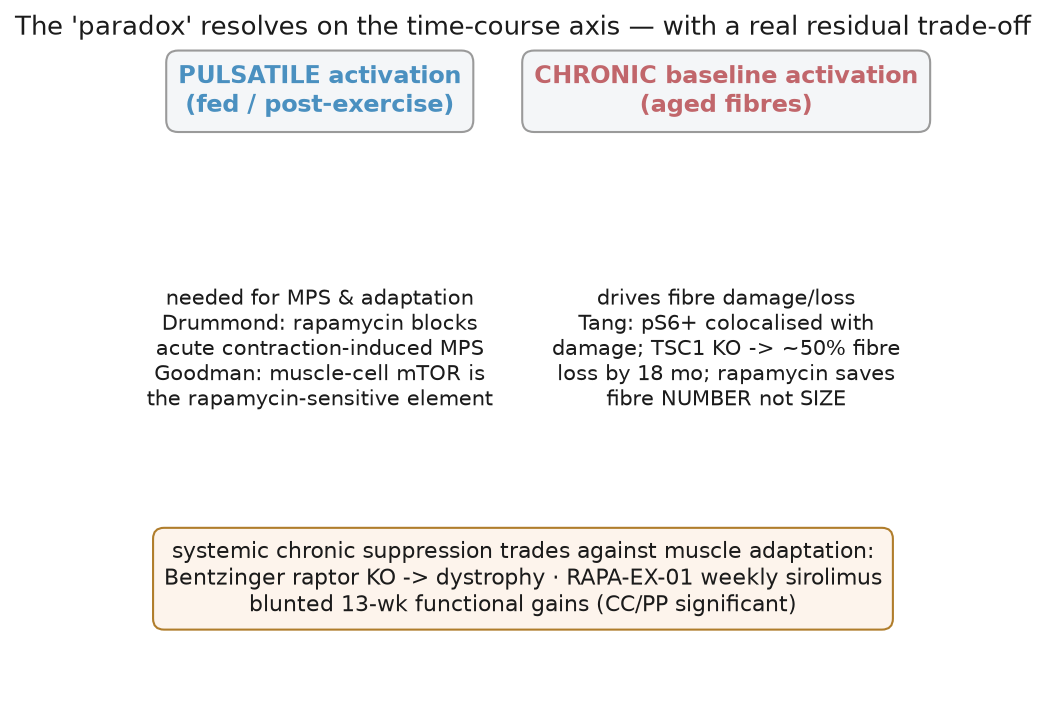
Stacking the four layers, what remains of the "paradox" is precise: muscle needs pulsatile mTORC1 (feeding/training-triggered), the pathology of aged muscle comes from sustained baseline activation, and the lifespan evidence requires chronically suppressing the systemic baseline — all three can be true at once, but the same chronic suppression measurably taxes the muscle side. Tang's data says it in one experiment: rapamycin preserved fibre number in aged muscle (benefit on the pathology side) but not fibre size or wet weight (the tax on the synthesis side); RAPA-EX-01 gave the same-direction signal at the human function layer.
Safety and boundaries
- Rapamycin/sirolimus: in RAPA-EX-01 total AE count was 99 vs 63 (+57%), including one possibly drug-related serious event (pneumonia); weekly 6 mg has a ~62-h half-life, so "pulsed dosing" effectively covers most of the training week — the "dose around the training window" cycling hypothesis was not supported within 13 weeks; longer intervals/lower doses untested.
- Protein intake: the evidence tops out at the ~1.6 g/kg/d training-gain breakpoint; higher intakes add no further mass; chronic-disease recommendations are in PROT-AGE (1.2–1.5 g/kg/d); individual conditions such as renal impairment are outside this article's scope.
- BCAA/isoleucine restriction: all-mouse evidence with no human layer; female effects markedly weaker (Green +7% vs +33%); no basis for population extrapolation.
- Function endpoints: at 13–24 weeks, function readouts are insensitive to moderate effects; "not detected" does not read as "equals zero".
Limitations and applicability
- Abstract-level sources (Drummond, PROVIDE, Verreijen, Wall, Tieland, Moore, Yang, Goodman, Bentzinger, Pennings, Cummings, Mannick ×2, PROT-AGE, Cermak) contributed abstract-reported values only; each is flagged by access level in the record; chronic-RCT between-arm effects are author-reported adjusted values, not our recomputation.
- Acute dose curves are schematic Hill reconstructions (parameters set to reported plateau doses), not individual-data fits; FSR protocols (mixed/myofibrillar, tracer) are not fully comparable across studies.
- RAPA-EX-01's significance concentrates in sensitivity analyses on a small sample; read "blunting" as a direction-consistent exploratory signal, not a verdict.
- Animal lifespan data have no human counterpart layer; mouse cancer-driven mortality differs from human causes of death.
- This article outputs no per-meal protein prescription and no medication advice.
Research and revision notes
This research was completed by Devin (agent); self-review was performed by the same agent and is not an independent review. Evidence archives (PMC full texts, abstracts, bibliographies, legacy post 957 snapshot) with SHA256 manifests are stored under evidence/protein-muscle-mtor-aging/; transcribed inputs and all analysis code live in research/calculations/protein-muscle-mtor-aging/; the reproduce.zip bundle and public figures sit in research/assets/protein-muscle-mtor-aging/. The formal self-review, score, and editorial sign-off are in the research record.
Sources
- <a id="source-s1"></a>Moore DR et al. Ingested protein dose response of muscle and albumin protein synthesis after resistance exercise in young men. Am J Clin Nutr 2009;89:161–8. (abstract level) PMID 19056590
- <a id="source-s2"></a>Yang Y et al. Resistance exercise enhances myofibrillar protein synthesis with graded intakes of whey protein in older men. Br J Nutr 2012. (abstract level) PMID 22313809
- <a id="source-s3"></a>Moore DR / Wall BT et al. Protein ingestion to stimulate myofibrillar protein synthesis requires greater relative protein intakes in healthy older versus younger men. J Gerontol A 2015. (abstract level) PMID 25056502
- <a id="source-s4"></a>Symons TB et al. A moderate serving of high-quality protein maximally stimulates skeletal muscle protein synthesis in young and elderly subjects. J Am Diet Assoc 2009. (PMC full text PMC3197704) PMID 19699838
- <a id="source-s5"></a>Pennings B et al. Whey protein stimulates postprandial muscle protein accretion more effectively than do casein and casein hydrolysate in older men. Am J Clin Nutr 2011. (abstract level) PMID 21367943
- <a id="source-s6"></a>Drummond MJ et al. Rapamycin administration in humans blocks the contraction-induced increase in skeletal muscle protein synthesis. J Physiol 2009. (abstract level) PMID 19188252
- <a id="source-s7"></a>Dickinson JM et al. Mammalian target of rapamycin complex 1 activation is required for the stimulation of human skeletal muscle protein synthesis by essential amino acids. J Nutr 2011. (PMC full text PMC3077888) PMID 21430254
- <a id="source-s8"></a>Tieland M et al. Protein supplementation increases muscle mass gain during prolonged resistance-type exercise training in frail elderly people. J Am Med Dir Assoc 2012. (abstract level) PMID 22770932
- <a id="source-s9"></a>Verreijen AM et al. A high whey protein-, leucine-, and vitamin D-enriched supplement preserves muscle mass during intentional weight loss in obese older adults. Am J Clin Nutr 2015. (abstract level) PMID 25646324
- <a id="source-s10"></a>Bauer JM et al. Effects of a vitamin D and leucine-enriched whey protein nutritional supplement on measures of sarcopenia in older adults, the PROVIDE study. J Am Med Dir Assoc 2015. (abstract level) PMID 26170041
- <a id="source-s11"></a>Bauer J et al. (PROT-AGE Study Group). Evidence-based recommendations for optimal dietary protein intake in older people. J Am Med Dir Assoc 2013. (abstract level) PMID 23867520
- <a id="source-s12"></a>Cermak NM et al. Protein supplementation augments the adaptive response of skeletal muscle to resistance-type exercise training: a meta-analysis. Am J Clin Nutr 2012. (abstract level) PMID 23134885
- <a id="source-s13"></a>Harrison DE et al. Rapamycin fed late in life extends lifespan in genetically heterogeneous mice. Nature 2009;460:392–5. (PMC full text PMC2786175) PMID 19587680
- <a id="source-s14"></a>Morton RW et al. A systematic review, meta-analysis and meta-regression of the effect of protein supplementation on resistance training-induced gains. Br J Sports Med 2018. (PMC full text PMC5867436) PMID 28698222
- <a id="source-s15"></a>Solon-Biet SM et al. The ratio of macronutrients, not caloric intake, dictates cardiometabolic health, aging, and longevity in ad libitum-fed mice. Cell Metab 2014. (PMC full text PMC5087279) PMID 24606899
- <a id="source-s16"></a>Bitto A et al. Transient rapamycin treatment can increase lifespan and healthspan in middle-aged mice. eLife 2016;5:e16351. (PMC full text PMC4996648) PMID 27549339
- <a id="source-s17"></a>Green CL et al. Dietary restriction of isoleucine increases healthspan and lifespan of genetically heterogeneous mice. Cell Metab 2023. (PMC full text PMC10655617) PMID 37939658
- <a id="source-s18"></a>Cummings NE et al. Restoration of metabolic health by decreased consumption of branched-chain amino acids. J Physiol 2018. (abstract level) PMID 29266268
- <a id="source-s19"></a>Mannick JB et al. mTOR inhibition improves immune function in the elderly. Sci Transl Med 2014. (abstract level) PMID 25540326
- <a id="source-s20"></a>Mannick JB et al. TORC1 inhibition enhances immune function and reduces infections in the elderly. Sci Transl Med 2018. (abstract level) PMID 29997249
- <a id="source-s21"></a>Stanfield B et al. Exercise and Weekly Sirolimus (Rapamycin) in Older Adults: RAPA-EX-01 Randomised, Double-Blind, Placebo-Controlled Trial. J Cachexia Sarcopenia Muscle 2026. (PMC full text PMC13082878) PMID 41985884
- <a id="source-s22"></a>Tang H et al. mTORC1 underlies age-related muscle fiber damage and loss by inducing oxidative stress and catabolism. Aging Cell 2019. (PMC full text PMC6516169) PMID 30924297
- <a id="source-s23"></a>Bentzinger CF et al. Skeletal muscle-specific ablation of raptor, but not of rictor, causes metabolic changes and results in muscle dystrophy. Cell Metab 2008. (abstract level) PMID 19046572
- <a id="source-s24"></a>Goodman CA et al. The role of skeletal muscle mTOR in the regulation of mechanical load-induced growth. J Physiol 2011. (abstract level) PMID 21946849
- <a id="source-s25"></a>Solon-Biet SM et al. Dietary protein to carbohydrate ratio and caloric restriction: comparing metabolic outcomes in mice. Cell Rep 2015. (PMC full text PMC4472496) PMID 26027933
Scope & limitations
- Abstract-level sources make up 15 of 25 (Moore/Yang/Wall/Tieland/Verreijen/PROVIDE/Cermak/PROT-AGE/Drummond/Bentzinger/Goodman/Pennings/Cummings/Mannick x2): only abstract-reported values were extracted, and between-group values are the papers' own adjusted figures, not our recomputation - divergence between methods and abstract would go undetected.
- RAPA-EX-01 is a 40-person, 13-week exploratory trial whose significance concentrates in sensitivity analyses with an imbalanced dropout (5 vs 3); its 'blunting' is a direction-consistent signal, not a verdict.
- Acute dose-response curves are schematic Hill reconstructions (parameters taken from published plateau values); FSR measurement conventions differ across studies (mixed vs myofibrillar, tracers), so the plateau shift is an interval, not a point.
- Animal lifespan data have no human counterpart layer; mouse cancer-dominated causes of death differ from human populations, and sex/strain/regimen conditionalities bound every extrapolation.
- Not a systematic review: the evidence set was selected by design feature (dose-response / same-training-background / lifespan layers), not exhaustive of all protein x training and rapamycin literature; the upstream cause of focal mTORC1 activation in aged muscle (denervation hypothesis) remains unresolved.
Sources
- Moore DR et al. Ingested protein dose response of muscle and albumin protein synthesis after resistance exercise in young men. Am J Clin Nutr 2009;89:161-8
paper · Source version: 2009
Reading scope
Abstract
- Abstract: 6 young men, 0/5/10/20/40 g whole-egg protein post-RE; MPS maximal at 20 g; leucine oxidation rises >=20 g
- Yang Y et al. Resistance exercise enhances myofibrillar protein synthesis with graded intakes of whey protein in older men. Br J Nutr 2012
paper · Source version: 2012
Reading scope
Abstract
- Abstract: ~71-y men, 0/10/20/40 g whey + RE; W20 +65% / W40 +90%; rested leg saturates at 20 g, exercised leg responds further to 40 g
- Moore DR/Wall BT et al. Protein ingestion to stimulate myofibrillar protein synthesis requires greater relative protein intakes in healthy older versus younger men. J Gerontol A 2015
paper · Source version: 2015
Reading scope
Abstract
- Abstract: plateau 0.40 vs 0.24 g/kg BW (p=0.055), 0.60 vs 0.25 g/kg LBM (p<0.01); basal MPS identical across age groups
- Symons TB et al. A moderate serving of high-quality protein maximally stimulates skeletal muscle protein synthesis in young and elderly subjects. J Am Diet Assoc 2009
paper · Source version: 2009; PMC3197704
Reading scope
Full text
BioC XML full text checked: 30 g protein meal FSR +~50%, no further gain at 90 g, consistent across age groups; discussion confirms the resting-ceiling reading.
- Full text: 113 g beef (30 g protein) FSR +~50%, 340 g (90 g) +~46%, same in both age groups; ~30 g/meal is the resting ceiling
- Pennings B et al. Whey protein stimulates postprandial muscle protein accretion more effectively than do casein and casein hydrolysate in older men. Am J Clin Nutr 2011
paper · Source version: 2011
Reading scope
Abstract
- Abstract: 48 men ~74 y, 20 g bolus; whey stimulates postprandial muscle protein accretion more than casein/hydrolysate
- Drummond MJ et al. Rapamycin administration in humans blocks the contraction-induced increase in skeletal muscle protein synthesis. J Physiol 2009
paper · Source version: 2009
Reading scope
Abstract
- Abstract: rapamycin completely blocks the early (1-2 h) contraction-induced rise in human MPS and S6K1 phosphorylation
- Dickinson JM et al. mTORC1 activation is required for the stimulation of human skeletal muscle protein synthesis by essential amino acids. J Nutr 2011
paper · Source version: 2011; PMC3077888
Reading scope
Full text
BioC XML full text checked: mTORC1 activation shown necessary for human MPS.
- Full text: mTORC1 activation is required for EAA-stimulated human MPS
- Tieland M et al. Protein supplementation increases muscle mass gain during prolonged resistance-type exercise training in frail elderly people. J Am Med Dir Assoc 2012
paper · Source version: 2012
Reading scope
Abstract
- Abstract: 62 frail elderly (78+/-1 y), 24-wk RE 2x/wk + 2x15 g/d protein; lean mass 47.2->48.5 (+1.3 kg) vs placebo 45.7 unchanged
- Verreijen AM et al. A high whey protein-, leucine-, and vitamin D-enriched supplement preserves muscle mass during intentional weight loss in obese older adults. Am J Clin Nutr 2015
paper · Source version: 2015
Reading scope
Abstract
- Abstract: 127 subjects, 13-wk weight loss + exercise; 1.11 vs 0.90 g/kg/d; appendicular lean mass +0.4 vs -0.5 kg, beta=0.95 kg (0.09-1.81) p=0.03; no functional between-group difference
- Bauer JM et al. Effects of a vitamin D and leucine-enriched whey protein nutritional supplement on measures of sarcopenia in older adults, the PROVIDE study. J Am Med Dir Assoc 2015
paper · Source version: 2015
Reading scope
Abstract
- Abstract: 380 sarcopenic elderly, 13 wk; greater chair-stand improvement; appendicular lean mass +0.17 kg (0.004-0.338) p=0.045; grip/SPPB no between-group difference
- Bauer J et al. (PROT-AGE) Evidence-based recommendations for optimal dietary protein intake in older people. J Am Med Dir Assoc 2013
paper · Source version: 2013
Reading scope
Abstract
- Abstract: >65 y recommendations 1.0-1.2 g/kg/d, >=1.2 for active, 1.2-1.5 in chronic disease
- Cermak NM et al. Protein supplementation augments the adaptive response of skeletal muscle to resistance-type exercise training: a meta-analysis. Am J Clin Nutr 2012
paper · Source version: 2012
Reading scope
Abstract
- Abstract: 22-RCT meta-analysis: lean mass +0.69 kg (0.47-0.91), 1RM leg press +13.5 kg (6.4-20.7)
- Harrison DE et al. Rapamycin fed late in life extends lifespan in genetically heterogeneous mice. Nature 2009;460:392-5
paper · Source version: 2009; PMC2786175
Reading scope
Full text
BioC XML full text checked: site-stratified lifespan data and both 600 d / 270 d cohorts verified.
- Full text: UM-HET3 from 600 d at 14 ppm; mean lifespan M +9% / F +13% (sites M 5-15%, F 7-16%); also effective from 270 d
- Morton RW et al. A systematic review, meta-analysis and meta-regression of the effect of protein supplementation on resistance training-induced gains. Br J Sports Med 2018
paper · Source version: 2018; PMC5867436
Reading scope
Full text
JATS XML full text checked: 49-RCT forest, 1.62 breakpoint, age moderation and subgroup tables verified.
- Full text: 49 RCTs, 1863 subjects; FFM +0.30 kg (0.09-0.52), 1RM +2.49 kg (0.64-4.33, ~9%); breakpoint 1.62 g/kg/d; age moderation -0.01 kg/yr p=0.002
- Solon-Biet SM et al. The ratio of macronutrients, not caloric intake, dictates cardiometabolic health, aging, and longevity in ad libitum-fed mice. Cell Metab 2014
paper · Source version: 2014; PMC5087279
Reading scope
Full text
BioC XML full text checked: 25-diet surface, mTOR-BCAA:glucose relationship and body-composition costs verified.
- Full text: 858 B6 mice, 25 diets; P:C ratio sets median lifespan ~95->125 wk (~30%); liver mTOR driven by BCAA:glucose (3x); low P:C simultaneously raises fat, lowers lean mass, fatty liver
- Bitto A et al. Transient rapamycin treatment can increase lifespan and healthspan in middle-aged mice. eLife 2016;5:e16351
paper · Source version: 2016; PMC4996648
Reading scope
Full text
JATS XML full text checked: injection/feeding regimens, sex-stratified lifespan tables, post-treatment LE convention and reviewer exchange verified.
- Full text: 20-mo B6, 3-month courses; injection 8 mg/kg/d male post-treatment life expectancy +60% (p=0.02), overall median +16%, females null; feeding 126 ppm sex-pooled median +13%
- Green CL et al. Dietary restriction of isoleucine increases healthspan and lifespan of genetically heterogeneous mice. Cell Metab 2023
paper · Source version: 2023; PMC10655617
Reading scope
Full text
BioC XML full text checked: HET3 sex-stratified lifespan, null all-AA control and frailty index verified.
- Full text: UM-HET3 from 6 mo, isoleucine -67%; male median +33% (max significant), female +7% (max null); all-AA -67% has no lifespan effect in HET3
- Cummings NE et al. Restoration of metabolic health by decreased consumption of branched-chain amino acids. J Physiol 2018
paper · Source version: 2018
Reading scope
Abstract
- Abstract: obese B6, BCAA -67% restores glucose tolerance/insulin sensitivity and reduces fat; FGF21/energy-expenditure mechanism; not a lifespan trial
- Mannick JB et al. mTOR inhibition improves immune function in the elderly. Sci Transl Med 2014
paper · Source version: 2014
Reading scope
Abstract
- Abstract: RAD001 6 weeks; influenza vaccine response +20%; tolerable
- Mannick JB et al. TORC1 inhibition enhances immune function and reduces infections in the elderly. Sci Transl Med 2018
paper · Source version: 2018
Reading scope
Abstract
- Abstract: 264 elderly, RTB101 +/- RAD001 16 wk; infection rate reduced, p=0.001
- Stanfield B et al. Exercise and Weekly Sirolimus (Rapamycin) in Older Adults: RAPA-EX-01 Randomised, Double-Blind, Placebo-Controlled Trial. J Cachexia Sarcopenia Muscle 2026
paper · Source version: 2026; PMC13082878; ACTRN12624000790549
Reading scope
Full text
JATS XML full text checked: ITT/CC/PP analyses, AE detail, half-life discussion and PEARL comparator section verified.
- Full text: 40 adults 65-85 y, weekly 6 mg (24 h after last weekly session) + 13-wk home exercise; ITT -2.13 reps (-4.61 to 0.34, p=0.089), CC -2.46 (p=0.045), PP -3.44 (p=0.007); secondary outcomes favour placebo non-significantly; AE 99 vs 63 (+57%), one pneumonia SAE; t1/2 ~62 h
- Tang H et al. mTORC1 underlies age-related muscle fiber damage and loss by inducing oxidative stress and catabolism. Aging Cell 2019
paper · Source version: 2019; PMC6516169
Reading scope
Full text
JATS XML full text checked: pS6+ fibre counts, TSC1 KO time course and the key negative result - rapamycin preserves fibre number not size (Suppl Fig S11).
- Full text: aged mouse/human pS6+ fibres 11%+/-2% and 3%+/-1% co-localising with damage/caspase; MCK-cre TSC1 KO -> ~50% gastrocnemius lateral-head fibre loss at 18 mo, ~39% survival; rapamycin 14 ppm from 270 d preserves fibre number but not fibre size/wet weight; GDF15-STAT3 mechanism
- Bentzinger CF et al. Skeletal muscle-specific ablation of raptor, but not of rictor, causes metabolic changes and results in muscle dystrophy. Cell Metab 2008
paper · Source version: 2008
Reading scope
Abstract
- Abstract: muscle raptor KO (mTORC1 off) -> progressive dystrophy and impaired oxidative capacity; rictor KO normal - muscle needs mTORC1
- Goodman CA et al. The role of skeletal muscle mTOR in the regulation of mechanical load-induced growth. J Physiol 2011
paper · Source version: 2011
Reading scope
Abstract
- Abstract: muscle-cell expression of rapamycin-resistant mTOR rescues load-induced hypertrophy - muscle mTOR is the rapamycin-sensitive element
- Solon-Biet SM et al. Dietary protein to carbohydrate ratio and caloric restriction: comparing metabolic outcomes in mice. Cell Rep 2015
paper · Source version: 2015; PMC4472496
Reading scope
Full text
BioC XML full text checked: P:C vs caloric restriction separation design verified.
- Full text: geometric-framework follow-up separating protein:carbohydrate ratio from caloric restriction effects
Authorship & review
Author self-review · Devin (AI agent)
2026-09-19 · The author's own focused review of the whole article, performed by the same agent: agreement between the main question (where the protein/muscle/mTOR 'paradox' actually lives - how acute signaling, chronic mass, function and lifespan evidence separate) and scope; actual reading depth of load-bearing sources (PMC full texts for Tang/Solon-Biet 2014/Bitto/Harrison/Green/Morton/Symons/Dickinson/RAPA-EX-01/Solon-Biet 2015; abstract or record level for the remaining 15); whether the analysis plan was locked before use; cell-by-cell checking of every load-bearing number against trial_data.py transcriptions and the full texts/abstracts; adjudication of five competing explanations (genuine trade-off / pulsed-vs-chronic / tissue specificity / dose nonlinearity / anabolic resistance); statistical calibration (schematic Hill reconstruction, papers' own adjusted values, sensitivity-analysis significance, RAPA-EX dropout imbalance); retention of unfavourable and boundary evidence (fiber number/size split, AE burden, weak female effects, all-AA restriction null in HET3, absent human lifespan layer); translation consistency and overstated claims; safety boundary (no intake prescription or drug advice). Method: mechanical checks first (zero CJK in the English file, identical anchors and figure numbers), then every load-bearing number against sources, then a 0-10 self-score; one revision round preceded the final rating. Rebound on 2026-09-18 to the version that adds the English localization of the record metadata (limitations, conflicts, source reading notes, review scopes): that change only adds localized fields, the record with the localized fields removed is byte-for-byte identical to the previous version (verified by git comparison), and it introduces no new research conclusion, number, source or qualification, so this score and the findings listed with it continue to apply to the current record. The English text of the localization was written and checked against the Chinese line by line by this agent.
Remaining limitations:
- This self-review was performed by the same agent that authored the article; it is not an independent, human, or professional review.
- Abstract-level sources make up 15 of 25: only abstract-reported values were extracted and between-group figures are the papers' own adjusted values, not our recomputation - divergence between methods and abstract would go undetected.
- RAPA-EX-01 is a 40-person, 13-week exploratory trial whose significance concentrates in sensitivity analyses with imbalanced dropout (5 vs 3); its 'blunting' reads as a direction-consistent signal, not a verdict.
- Acute dose-response curves are schematic Hill reconstructions; FSR measurement conventions differ across studies, so the plateau shift is an interval, not a point.
- Not a systematic review: the comparator set was selected by design feature, not exhaustive of all protein x training and rapamycin literature; the upstream cause of focal mTORC1 activation in aged muscle (denervation hypothesis) remains unresolved.
Editorial approval · Devin (AI agent)
2026-09-19 · Editorial sign-off executed by the same agent that authored the article, explicitly in a different working role - not independent, human, or professional review. Checked against the publication-blocking list: (1) source identity and versions - PMC full texts for Tang/Solon-Biet 2014/Bitto/Harrison/Green/Morton/Symons/Dickinson/RAPA-EX-01/Solon-Biet 2015 and abstract-level bibliographies for the remaining 15 sources verified one by one; evidence SHA256-archived; (2) no conclusions contrary to the sources - rapamycin preserving fibre number but not fibre size, the RAPA-EX functional blunting signal, the +57% AE burden, weak female effects, all-AA restriction null in HET3, and inconsistent mass-to-function translation are all retained; (3) denominators and statistical objects - the ITT/CC/PP conventions, the 5:3 dropout imbalance, sensitivity-analysis significance, the schematic Hill reconstruction, and papers' own adjusted values are all stated; (4) model assumptions are not used to prove reality - the reconstruction is not an individual-data fit, there is no human lifespan layer, and between-group values are not our recomputation; (5) safety gaps - no intake prescription or drug advice is given and population boundaries are stated; (6) public scope is evidence description, so professional review is not triggered. This sign-off covers the current version of the English text and confirms that its negations, directions of comparison, units, intervals and qualifications agree with the Chinese and with the main record, with nothing stated more strongly than in the Chinese. Rebound on 2026-09-18 to the version that adds the English localization of the record metadata (limitations, conflicts, source reading notes, review scopes): that change only adds localized fields, the record with the localized fields removed is byte-for-byte identical to the previous version (verified by git comparison), and it introduces no new research conclusion, number, source or qualification, so this score and the findings listed with it continue to apply to the current record. The English text of the localization was written and checked against the Chinese line by line by this agent.
Translation check · Devin (AI agent)
· The same agent wrote the English text independently from the same evidence record and then compared it section by section against the Chinese. Checked: identical statistics (Wall 0.40/0.24 g/kg BW p=0.055, 0.60/0.25 g/kg LBM p<0.01, basal MPS 0.027/0.028; Yang +65%/+90%; Moore 20 g; Symons ~50%/~46%; Tieland +1.3 kg; Verreijen beta=0.95 kg (0.09-1.81) p=0.03; PROVIDE +0.17 kg (0.004-0.338) p=0.045; Cermak +0.69/+13.5 kg; Morton +0.30/+2.49, breakpoint 1.62, -0.01 kg/yr p=0.002, ~9% protein share; Tang 11%+/-2% vs 3%+/-1%, ~50% fibre loss, ~39% survival; Harrison M+9%/F+13%; Bitto male +60% post-treatment LE/+16% median, feeding +13%; Solon-Biet ~95->125 wk ~30%; Green M+33%/F+7%; RAPA-EX ITT -2.13 (-4.61 to 0.34, p=0.089), CC -2.46 (p=0.045), PP -3.44 (p=0.007), AE 99 vs 63, t1/2 ~62 h); every qualification preserved in English (threshold shift not direction reversal; fibre number preserved but not size; sensitivity-analysis significance; all-AA restriction null in HET3; no human lifespan layer); and whether the English anywhere states something more strongly than the Chinese - it does not. Terminology and the rendering of statistics are consistent throughout. This is not an independent second-party language check. Rebound on 2026-09-18 to the version that adds the English localization of the record metadata (limitations, conflicts, source reading notes, review scopes): that change only adds localized fields, the record with the localized fields removed is byte-for-byte identical to the previous version (verified by git comparison), and it introduces no new research conclusion, number, source or qualification, so this score and the findings listed with it continue to apply to the current record. The English text of the localization was written and checked against the Chinese line by line by this agent.
Funding & interests
None. This article is an evidence-layering exercise over published group-level summaries plus schematic reconstructions.
Funding of cited research
The Mannick 2014/2018 trials were sponsored by Novartis (resTORbio programme); RAPA-EX-01 was investigator-initiated. Disclosed as relevant context.